Call or text us! (703) 928-7309
Building a Business Case for a New Website: The Executive Guide for 2026

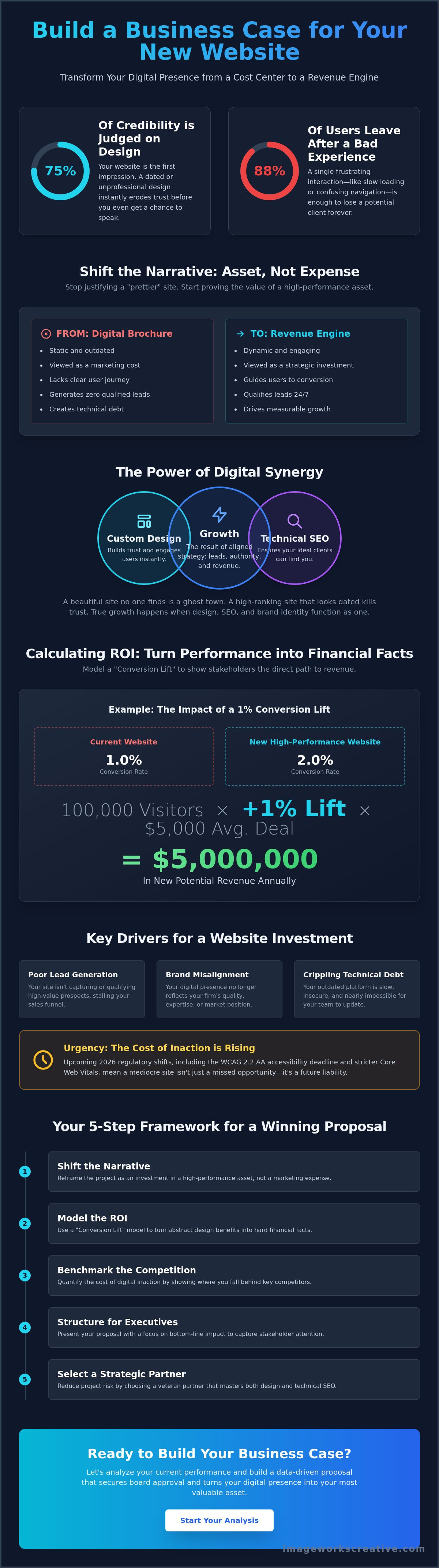
75% of your company's credibility is judged solely on its website design. If your platform feels like a digital brochure rather than a revenue engine, you're likely losing 88% of users after just one bad experience. You're here because building a business case for a new website requires more than a request for a "prettier" look. It demands strategic alignment between your brand identity and measurable growth.
We understand the struggle of quantifying a high-performance site to a skeptical board. You're facing internal resistance and a valid fear of scope creep. It's hard to justify costs when you can't see the direct line to the bottom line. This guide changes that. You'll learn how to secure stakeholder buy-in using ROI frameworks that prove why a custom web design is an investment, not an expense.
We'll explore the cost of inaction, including 2026 regulatory shifts like the Washington state WCAG 2.2 AA deadline and tightened Core Web Vitals thresholds. From leveraging search engine optimization to choosing the right website maintenance plans, we'll provide the roadmap to turn your digital presence into a competitive advantage.
Key Takeaways
- Shift the internal narrative from a simple expense to a high-performance asset. Learn how to align your digital presence with your firm's long-term growth strategy.
- Use concrete ROI modeling to turn abstract design ideas into financial facts. Discover how a small conversion lift can lead to measurable revenue gains.
- Quantify the real cost of digital inaction by benchmarking your site against the competition. This is a vital step when building a business case for a new website that wins board approval.
- Follow a structured five-step framework to present your proposal with confidence. Learn to highlight the bottom-line impact immediately to capture executive attention.
- Reduce project risk by choosing a veteran partner with synergy between custom web design and technical search engine optimization.
Identifying the Strategic Drivers for a Website Investment
Stop viewing your digital presence as a recurring bill. It is an engine. For most firms, the website is the first and most frequent point of contact for potential clients. It works while your team sleeps. It qualifies leads while you're in meetings. When we look at what is a business case, we're defining a strategic justification for capital expenditure. It's the bridge between a creative vision and a board-room reality. Building a business case for a new website requires you to shift the narrative from "marketing cost" to "investment in a high-performance asset."
Every successful proposal starts by identifying the primary driver. Are you struggling with lead generation? Is your brand repositioning itself for a more sophisticated market? Perhaps you're buried under technical debt that makes updates impossible. Whatever the catalyst, your website functions as the 24/7 face of your firm. If that face looks tired or fails to answer the user's needs, your growth stalls. In 2026, a mediocre site isn't just a missed opportunity; it's a liability that actively pushes prospects toward your competitors.
The Concept of Digital Synergy
A beautiful site that no one finds is a ghost town. Conversely, a high-ranking site that looks dated kills trust instantly. We believe in synergy. Design, search engine optimization, and brand identity must function as a single unit. A sophisticated aesthetic wins the initial engagement, but technical SEO architecture ensures you're visible in the first place. When these elements align, they create a compound effect that drives authority and conversion. Without this integration, you're just buying a digital brochure that won't move the needle.
Aligning Website Goals with Firm Objectives
Your digital goals can't exist in a vacuum. They must map directly to your 2026 revenue targets. We look for "leaky buckets" in the current user journey where potential clients drop off. Is it a slow load time? A confusing navigation? By fixing these friction points, we turn traffic into predictable growth. For B2B professional services, success goes beyond simple hits. It's about client retention and high-value lead capture. When building a business case for a new website, focus on these outcomes. Show the stakeholders how a modernized platform supports the firm's broader mission and stabilizes the sales funnel through consistent website maintenance plans.
Calculating ROI: Turning Digital Performance into Financial Facts
Numbers don't lie. They persuade. When you're building a business case for a new website, you must move beyond aesthetic preferences and into the world of hard financial data. Start with your baseline. If your current conversion rate is 1% while industry benchmarks sit at 3%, you aren't just missing out on traffic; you're losing revenue every single day. Modeling a "Conversion Lift" is the most effective way to capture executive attention. A mere 1% increase in conversion, when applied to your annual traffic, can translate into significant new billings for a professional firm.
Efficiency is another massive part of the equation. Modern platforms allow for automated lead nurturing and seamless CRM integration. This reduces the manual workload for your sales team and ensures no high-value prospect slips through the cracks. You also need to factor in the cost of keeping your old site alive. Long-term savings from reduced website maintenance on legacy systems often offset the initial investment within a few years. Public sector entities and private firms alike are increasingly justifying website upgrades by focusing on user experience and the high cost of maintaining fragmented, outdated systems. If you're ready to see how these numbers apply to your specific firm, we can help you analyze your current performance.
The Mathematical Path to Approval
To win approval, you must calculate the average Client Lifetime Value (LTV) against your acquisition costs. If a single new client brings in $50,000 in lifetime revenue, and your new site generates just ten additional leads per year, the investment pays for itself almost immediately. Projecting lead growth becomes much easier when you account for search engine optimization and mobile-first UX. With mobile devices accounting for approximately 62% to 64% of global web traffic in 2026, a site that fails the responsiveness test is essentially invisible to more than half of your market. ROI in the professional services sector is defined by the quality and volume of high-intent leads your platform captures.
Intangible Benefits with Tangible Impact
Some benefits are harder to track in a spreadsheet but just as vital for growth. A high-caliber design plays a critical role in recruitment. Top-tier talent will judge your firm's innovation and stability by your digital presence. This visual authority often dictates whether a candidate even submits an application. Additionally, established brand authority reduces the sales cycle duration. When a prospect visits a professional, bespoke site, trust is established before the first phone call. This social proof accelerates the decision-making process and positions your firm as the obvious choice in a crowded market.
Competitive Benchmarking and the True Cost of Digital Inaction
Your competitors aren't waiting for your permission to innovate. While you weigh the pros and cons of an update, more agile firms are actively siphoning off your market share. Analyzing the digital footprint of your peers often reveals where your firm is leaking leads. If their sites load faster, rank higher, and offer a more seamless experience, they are winning the trust of your potential clients before you even get a chance to bid. Inaction is a choice. It's a costly one.
The most common objection to building a business case for a new website is the "if it isn't broken, don't fix it" mentality. This is a dangerous trap. A site that "works" but fails to meet 2026 technical standards is effectively broken. It's invisible to search engines and frustrating to users. Google's March 2026 core update tightened the threshold for a "Good" Largest Contentful Paint (LCP) score to under 2.0 seconds. If your site lags behind this benchmark, you are losing search visibility to competitors who prioritize performance. Staying with an obsolete site isn't playing it safe; it's choosing to fall behind.
Risk Mitigation: Security and Compliance
Legal and financial risks are now central to the business case. For instance, Washington state requires that information technology for public entities conforms with WCAG 2.2 AA by July 1, 2026. Healthcare organizations receiving HHS funding faced a similar deadline on May 11, 2026. Non-compliance is no longer just a design flaw; it's a legal liability. Beyond accessibility, hosting on insecure legacy platforms invites catastrophic data breaches. A custom build supported by website maintenance plans ensures long-term stability and timely security patches that off-the-shelf solutions simply can't match.
User Experience (UX) as a Competitive Weapon
In the tech and legal sectors, your digital experience is your brand. High-value clients have zero patience for friction. If your mobile performance is poor, especially since mobile devices account for a majority of global traffic, you've lost the battle before it started. We use AI intelligence and human expertise to identify exactly where your current site frustrates users. Benchmarking your site speed and Interaction to Next Paint (INP) against industry leaders turns UX into a weapon for growth. A professional, bespoke experience doesn't just look better. It builds the trust required to win high-caliber contracts.
Structuring Your Business Case: A Five-Step Executive Framework
A winning proposal doesn't just ask for money. It presents a solution to a problem the board didn't realize was costing them. When you're building a business case for a new website, your structure should be as clean and purposeful as the site you're proposing. Start with an Executive Summary that highlights bottom-line impact immediately. Don't lead with colors or fonts. Lead with how this investment will stabilize lead flow and protect market share in a competitive 2026 environment. You want stakeholders to see a roadmap to growth, not a drain on resources.
Step 1 & 2: The Hook and the Evidence
You need a compelling "Why Now?" narrative to capture attention. Use heatmaps and analytics to show exactly where potential clients are abandoning your current platform. If 88% of users are unlikely to return after one bad experience, show the data that proves your current site is that experience. We reference high-end custom website design services to set the standard for what a professional firm requires in this decade. It's not about making things pretty; it's about removing the friction that stops a high-value contract from signing. Evidence-based arguments turn subjective design debates into objective business decisions when building a business case for a new website that stakeholders can't ignore.
Step 3, 4 & 5: The Solution and the Numbers
The solution must be bespoke. For professional firms, off-the-shelf templates are a liability because they lack the unique brand identity required to build trust in a crowded market. Your proposal should detail the synergy between creative elements and technical search engine optimization. For 2026, a complex WordPress build integrates component-driven development and AI-enhanced testing to ensure every line of code serves both human users and AI discovery agents. This technical proficiency is what justifies the investment and ensures long-term viability.
Finally, outline the financial plan and the roadmap. Your budget must include both the initial project-based fees and ongoing website maintenance plans to ensure the asset doesn't depreciate over time. A website is a living entity. It requires regular updates and content marketing to maintain its competitive edge. Setting realistic expectations for the launch and the optimization phases that follow prevents the fear of project scope creep. Ready to build a proposal that gets a "yes"? Let's finalize your digital strategy together.
Selecting a Strategic Partner to Execute Your Business Case
You've done the hard work of building a business case for a new website. Now comes the phase where that vision becomes a reality. Choosing a partner isn't just about finding someone who can write code; it's about finding a veteran who understands the stakes of your investment. An agency with over 25 years of experience brings a level of stability that reduces project risk. They've navigated every major digital shift since the nineties. This history ensures they won't be learning on your dime. They've already mastered the complexities of high-performance builds.
Synergy is the most critical factor to look for in a partner. Does the agency handle design, development, and search engine optimization in-house? When these departments function as a single unit, the result is a cohesive engine rather than a collection of parts. If your SEO strategy doesn't inform your site architecture from day one, you're building on a shaky foundation. Evaluating portfolios for industry-specific expertise in Legal, Medical, or Tech sectors is equally vital. These fields require a deep understanding of compliance and high-ticket lead generation that generic agencies often miss.
Vetting for Performance and Achievement
Look for achievement that goes beyond surface-level aesthetics. Award-winning design is a plus, but it must be paired with technical results that show up in your analytics. Does the agency understand high-ticket, service-based business models? In sectors like B2B professional services, the user journey is a sophisticated path to trust. You need a partner who acts as a visionary guide, not just a vendor who takes orders. They should use a data-driven approach to challenge your assumptions and offer bespoke solutions that align with your specific revenue targets.
Finalizing the Partnership
A successful launch is only the first milestone. You need to understand the transition from the initial project build to a growth-focused marketing retainer. This is where website maintenance plans and packages become essential to protect your asset. Ensure that direct, human-to-human dialogue is part of the agency's DNA. You should have a responsive partner who is as invested in your growth as you are. This level of accessibility distinguishes a proactive firm from a rigid, traditional agency. We use AI intelligence and human expertise to ensure your site remains a competitive weapon long after the initial launch.
Ready to build your case? Contact ImageWorks Creative for a strategic consultation.
Future-Proofing Your Firm’s Digital Growth
A high-performance website isn't a static expense. It's the primary engine for your firm's growth in 2026. By shifting the conversation from cost to investment, you align your digital presence with actual revenue targets. You've seen how building a business case for a new website requires a blend of hard data, competitive benchmarking, and a clear implementation roadmap. Whether it's meeting new accessibility deadlines or capturing a 1% conversion lift, the price of waiting is simply too high.
Success depends on synergy. Since 1997, we've helped firms in the legal, medical, and tech sectors turn their websites into high-caliber assets. We combine award-winning design with technical SEO to ensure your platform doesn't just look exceptional but performs at the highest level. You don't have to navigate this transition alone. We're here to act as your visionary guide and strategic partner.
Secure your firm's future with a bespoke digital strategy from ImageWorks Creative. Let's build something that drives measurable results for years to come.
Frequently Asked Questions
What should be included in a website business case?
A comprehensive case includes an executive summary focused on revenue, a data-driven problem statement, and a solution detailing technical synergy. You must outline a clear financial plan that covers initial custom web design alongside ongoing marketing retainers. It's about showing how the platform functions as a growth engine rather than just a digital brochure.
How do I calculate the ROI of a new website redesign?
Start by establishing a baseline conversion rate and modeling a lift based on industry benchmarks. If a 1% increase in conversion leads to ten additional high-value contracts, the revenue gain is easy to project. You should also factor in the value of automated lead nurturing and the long-term savings from reduced website maintenance on legacy systems.
How much does a custom professional service website cost in 2026?
Investment levels vary significantly based on technical complexity and the depth of required integrations. Factors like bespoke branding, complex WordPress development, and advanced security protocols influence the final scope. It's best to consult with a specialist to define your specific requirements rather than relying on generic industry estimates that may not reflect your firm's unique needs.
What are the biggest risks of not updating our current website?
The primary risks include search visibility loss and legal liability. Google’s 2026 updates tightened performance thresholds, meaning slow sites are actively being pushed down in rankings. Additionally, 88% of users won't return to a site after a single bad experience. Staying with an obsolete platform effectively hands your market share to more agile competitors who prioritize user experience.
How do I convince my Board that we need a custom build over a template?
Focus the argument on scalability and brand authority. Templates carry heavy technical debt and limit your ability to stand out in a crowded market. A custom build ensures your site is engineered for search engine optimization from day one. Explain that a bespoke solution is a long-term asset that grows with the firm, while a template is a short-term fix that often requires a total rebuild within two years.
What is the typical timeline for a custom WordPress development project?
A high-end build typically moves through discovery, design, development, and rigorous testing over several months. This ensures every component is optimized for speed and accessibility. While simple sites might launch faster, a strategic platform requires time to align the AI intelligence and human expertise necessary for a top-tier result. Rushing the process often leads to technical gaps that hurt performance later.
How does ADA compliance affect the business case for a new site?
ADA compliance is a mandatory legal requirement that mitigates significant financial risk. For instance, Washington state requires public entities to meet WCAG 2.2 AA standards by July 1, 2026. Healthcare organizations receiving HHS funding faced similar deadlines earlier this year. Building a business case for a new website must prioritize these regulations to protect the firm from potential litigation and ensure an inclusive experience for all users.
Should SEO be part of the initial website business case or a separate project?
SEO must be integrated into the initial case to ensure technical synergy. If you treat search engine optimization as an afterthought, you'll likely have to rework the site's architecture later at a higher cost. Engineering the site for discovery from the beginning ensures that your new investment actually reaches your target audience and generates the leads your business case promises.