Common Website Design Mistakes: Why Your Digital Presence is Stalling Growth

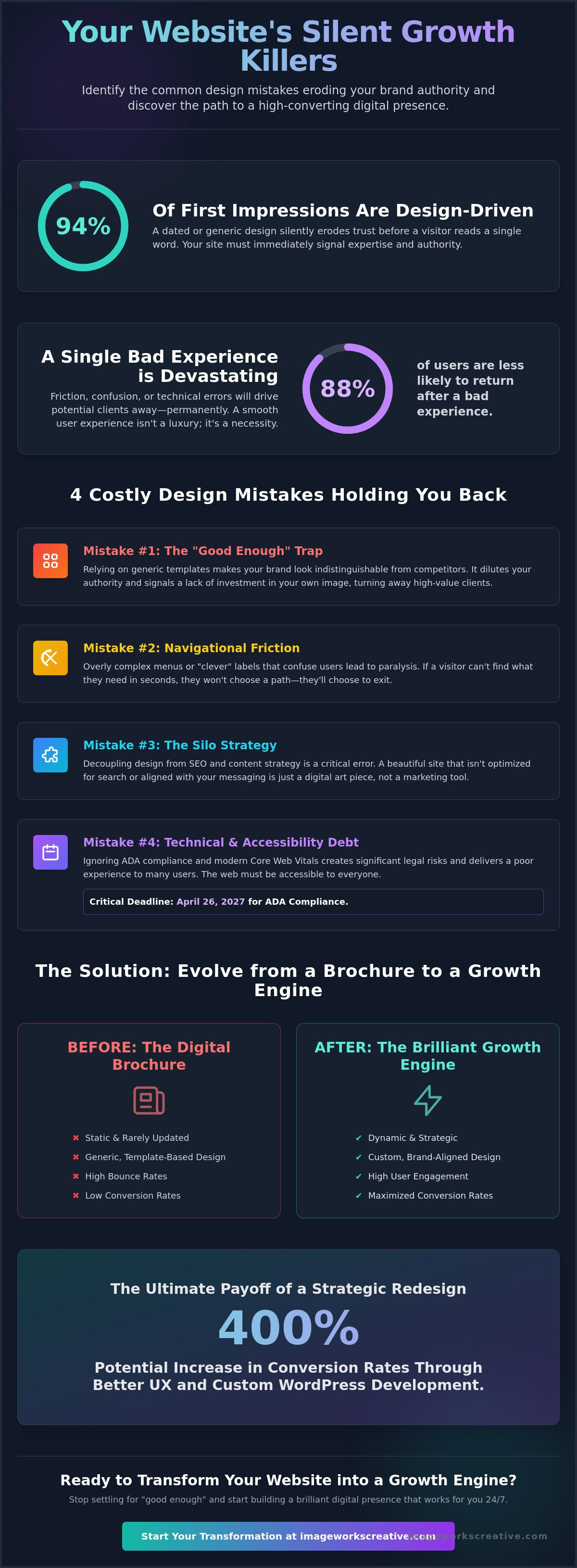
Did you know that 94% of first impressions are driven entirely by design? If your digital presence feels dated compared to the competition, your brand authority is quietly eroding before a visitor even reads your first sentence. You've likely noticed the symptoms: decent traffic but low conversion rates, or high bounce rates on your most important service pages. It's frustrating to see potential growth stall when you know your business is brilliant. You deserve a site that acts as a 24/7 growth engine, not a digital brochure.
We're here to help you bridge the gap between marketing strategy and visual design. In this guide, we'll identify the common website design mistakes that act as strategic silos, preventing your site from performing. You'll learn how to fix these technical and aesthetic errors to create a future-proofed presence. We'll preview the path to a 400% increase in conversion rates through better UX and explain why meeting the April 26, 2027, ADA compliance deadline is a business imperative. It's time your website and marketing finally started working together.
Key Takeaways
- Stop settling for generic templates that dilute your authority and learn to identify common website design mistakes that create friction for your visitors.
- Simplify your navigation by replacing clever labels with clear ones to eliminate user paralysis and drive higher conversion rates on key service pages.
- Embrace a "Built to Work Together" philosophy where content and SEO aren't afterthoughts but core components of your visual design strategy.
- Protect your firm from legal and ethical risks by understanding the updated 2027 ADA compliance standards and optimizing for modern Core Web Vitals.
- Shift your perspective from owning a static digital brochure to launching a brilliant growth engine through custom WordPress development.
The Trap of "Good Enough": Why Generic Design Fails Professional Firms
Settling for a website that is just "fine" is the fastest way to stall your firm's growth. Identifying common website design mistakes is the first step toward reclaiming your brand's online authority and turning your digital presence into a 24/7 growth engine. We define a design mistake as any element that creates friction between the user and your brand promise. When a potential client arrives, they are searching for a reason to trust you. If your site presents obstacles instead of solutions, you've already lost the battle for their attention.
When analyzing common website design mistakes, the reliance on off-the-shelf templates is often at the top of the list. These generic frameworks dilute your unique professional authority because they were built for the masses, not for a brand that aims for a "Brilliant" standard. A "pretty" site is useless if it doesn't communicate your value proposition in under 3 seconds. Since 94% of first impressions are design-driven, your site must move beyond basic functionality to aspirational design. If you don't signal expertise immediately, visitors will bounce to a competitor who looks the part. This is a costly error, as 88% of online users are less likely to return to a website after a single bad experience.
The Aesthetic vs. Strategic Gap
Following generic design trends can make your firm look like every other player in the market. True success comes from custom brand identity integration that moves beyond mere aesthetics. Understanding foundational web design principles is a great starting point, but your user interface must be built around your specific marketing goals. Every button, font choice, and layout decision should serve a strategic purpose. The "Good Enough" trap is a silent killer of professional credibility that tricks high-growth firms into appearing stagnant and replaceable.
Misaligned Brand Voice and Visuals
Inconsistent typography and generic color palettes confuse high-ticket prospects who expect a certain level of sophistication. If your copy speaks like an industry leader but your visuals look like a DIY project, the cognitive dissonance will drive users away. Custom photography is essential here; generic stock images often scream "average" to a discerning audience. Your website must reflect the "Proactive Partner" personality of your firm, showing that you are visionary and deeply integrated into your client's success. By aligning your brand voice with your visual identity, you create a cohesive narrative that builds lasting trust.
Navigational Friction: How Complex Menus Kill Conversions
Your navigation is the digital roadmap of your business. If that map is cluttered or confusing, your visitors will simply pull over and leave. One of the most common website design mistakes we encounter is the "Paradox of Choice." When you overwhelm a prospect with twenty different menu options, you trigger user paralysis. Instead of choosing a path, they choose the exit. A brilliant website guides the user with confidence; it doesn't leave them guessing which link holds the answer to their problem.
Clarity must always trump cleverness. We often see firms replace standard labels like "About Us" or "Services" with abstract phrases like "Our Journey" or "The Nexus." While these might feel creative, they create unnecessary friction. Forbes notes that many common business website features that can be a problem stem from this desire to be unique at the expense of usability. If a visitor can't find what they need in three seconds, your brand authority takes a hit. Every subpage must provide a logical "Next Step." Don't let your high-value content become a dead end that forces a user to hit the back button. Success requires a proactive approach to flow.
Designing for the Scannable Reader
Modern users don't read every word on your page. They scan in an "F-Pattern," looking for headlines and bullet points that validate their search. You can break the "Wall of Text" by using a strategic H2 and H3 hierarchy combined with generous whitespace. This visual breathing room isn't just an aesthetic choice; it's a conversion tool. Use subtle visual cues like contrasting colors or bold typography to highlight resources. This allows you to promote your expertise without making your site look like a cluttered marketplace. Professional custom web design ensures your most important information is always the easiest to find.
The Mobile-First Navigation Failure
Desktop-first thinking is a relic. Mobile devices account for over 63% of all web traffic in 2026, and 85% of users expect your mobile experience to be as good as, or better than, your desktop site. Common mobile UX sins include unclickable buttons that are too close together and intrusive pop-ups that are impossible to close. Your most critical contact information and primary call to action must be "thumb-accessible" on every device. If a user has to pinch and zoom to find your phone number, your digital presence is stalling your growth. We build sites where mobile functionality is a priority, not an afterthought, ensuring your brand is accessible everywhere.
The "Silo" Mistake: Decoupling Design from SEO and Content Strategy
Design and marketing are often treated as separate stages of a project, but this disconnect is a recipe for a stagnant digital presence. At ImageWorks Creative, we believe every brilliant website must be "Built to Work Together" from the very first wireframe. When you isolate visual aesthetics from your Search Engine Optimization (SEO) goals, you create a beautiful shell that no one can find. This "silo" approach is one of the most common web design mistakes that professional firms make today. True success requires a proactive partnership where every pixel serves a strategic purpose.
The "Lorem Ipsum" trap is a primary example of this failure. Treating content as an afterthought, filling bespoke layouts with placeholder text, ensures your design will never truly support your brand promise. Content should dictate the design, not the other way around. Failing to account for search intent is one of those common website design mistakes that prevents your site from acting as a true growth engine. If your layout doesn't emphasize your high-intent keywords and unique value propositions, you're essentially designing for a ghost. Your digital presence should move beyond generic discovery to capture prospects who are ready to engage.
Technical SEO is another area where design choices often sabotage performance. Heavy, unoptimized images might look stunning on a high-resolution monitor, but they crush your Core Web Vitals. In 2026, Google's ranking factors prioritize Interaction to Next Paint (INP) and Largest Contentful Paint (LCP). A site that takes longer than 3 seconds to load is considered slow by modern standards, and users won't wait. By integrating technical SEO into the design phase, we ensure your site is fast, secure, and easily crawlable without sacrificing its creative energy.
Design That Supports Authority
Google prioritizes Experience, Expertise, Authoritativeness, and Trustworthiness (E-E-A-T) in its ranking algorithms. Your design must showcase these traits through custom layouts that highlight case studies, white papers, and team credentials. It's not just about having the information; it's about how that information is presented. A well-designed internal linking architecture within the UI guides users toward deeper engagement, turning a single visit into a lasting relationship. This is how you move from a vendor to a guide in the eyes of your prospects.
The Failure of the Conversion Funnel
High-end websites often fail because they only provide one "Next Step": a single button buried at the bottom of the page. This ignores the reality that visitors are at different stages of their journey. Your site needs distinct paths for Top-of-Funnel (TOFU), Middle-of-Funnel (MOFU), and Bottom-of-Funnel (BOFU) visitors. Strategic placement of trust signals, such as client highlights and industry awards, builds confidence at every touchpoint. When your design and content strategy work in synergy, you can increase conversion rates by up to 400% through superior user experience.
Technical Debt and the Accessibility Oversight
Technical debt is the price you pay for taking shortcuts during the development process. It's a silent growth killer that accumulates every time a site is built without a long-term strategy. Many firms treat their website as a "set it and forget it" project, but this is one of the most damaging common website design mistakes. A site that isn't maintained becomes a liability, riddled with broken plugins and security leaks that erode the trust you've worked so hard to build. We believe in building digital assets that are as stable as they are brilliant, ensuring your foundation is ready for the future.
Ignoring the underlying architecture of your site leads to performance lag that no amount of creative design can fix. In 2026, a 3-second load time is no longer an industry standard; it's considered slow. Google's Core Web Vitals now place a heavy emphasis on Interaction to Next Paint (INP), meaning your site must feel instantaneous to the user. Neglecting high-performance WordPress hosting or failing to implement a proactive Website Maintenance Plan creates a friction-filled experience. This technical friction directly impacts your bottom line, as every $1 invested in User Experience (UX) can return up to $100 in business value.
ADA Compliance as a Design Standard
Digital accessibility is a legal and ethical imperative that can't be ignored. The U.S. Department of Justice (DOJ) recently updated Title II of the Americans with Disabilities Act (ADA) to include specific requirements for web accessibility. For state and local government entities with a population of 50,000 or more, the compliance deadline is now April 26, 2027. Healthcare organizations receiving HHS funding have an even tighter window, with a deadline of May 11, 2026. Following the WCAG 2.1 Level AA standard ensures your site is usable for everyone, regardless of their abilities. Accessibility is no longer an "add-on" but a foundational requirement for any professional digital presence. If you aren't sure where your current site stands, we can help you identify risks with a professional ADA Compliance Audit.
Performance and Security Architecture
The hidden cost of "cheap" hosting is far higher than the monthly savings. Low-tier servers often lack the security protocols and speed necessary for professional service sites to rank in 2026. Regular technical audits are essential to identify vulnerabilities before they become crises. As we move toward more AI-driven search and voice-activated queries, your site's structure must be clean and crawlable. A proactive approach to security and performance architecture future-proofs your brand, allowing you to focus on growth while we handle the technical heavy lifting. We don't just build sites; we build secure, high-speed engines designed to scale with your ambition.
Moving from a "Website" to a Brilliant Growth Engine
Stop thinking about your website as a line item on a balance sheet. Start viewing it as your most tireless employee. The difference between a stagnant site and a high-performing one often comes down to who you choose to build it. A vendor simply checks boxes to "build a site." A proactive partner, however, works to "build a business." This distinction is vital when moving past common website design mistakes that have historically held your brand back. We focus on the synergy between visual brilliance and strategic results, ensuring every element is built to work together.
Custom WordPress development remains the gold standard for high-growth firms for a reason. It offers the flexibility to evolve as your market shifts and the power to integrate complex marketing tools without compromising speed. When you invest in a data-driven design process, you aren't just buying a layout. You're securing a return on investment that manifests in higher conversion rates and stronger brand authority. A site that looks high-end must also perform at a high level to survive the scrutiny of modern prospects. We've seen that a well-designed user interface can increase conversion rates by up to 200%, making the move to custom development a clear strategic win.
The Power of a Proactive Partnership
Finding an agency that understands both pixels and profit is rare. You need a team that sees the creative potential in a landing page while obsessing over the analytics behind it. The most successful firms don't stop at the launch. They utilize ongoing marketing retainers and custom development to ensure their site remains a living entity that grows with them. This collaborative enthusiasm allows your digital presence to adapt to new trends and algorithm changes in real time. We stay deeply integrated into your success because your growth is the ultimate metric of our brilliance.
Your Blueprint for Digital Success
The journey from a dated, friction-filled site to a brilliant growth engine requires a holistic approach. It's not enough to fix a few broken links or update a logo. You must align your branding, SEO, and UX into a single, cohesive strategy. We've navigated the evolution of the internet since 1997, and we know what lasts. By identifying the common website design mistakes sabotaging your growth, you can finally clear the path for true digital transformation. It's time to stop stalling and start scaling. You can take the first step today and Audit your current site with the experts at ImageWorks Creative.
Claim Your Digital Authority
Your digital presence should never be a source of friction. By addressing common website design mistakes like navigational clutter and decoupled SEO strategies, you're doing more than just fixing a site; you're building a foundation for long-term scalability. Every second of load time and every missed accessibility standard directly impacts your bottom line. Success in 2026 requires a proactive partner who understands that design and marketing are Built to Work Together. Excellence is the only standard that lasts.
Since 1997, ImageWorks Creative has served as a trusted guide for firms in the legal, medical, and tech sectors. We are custom WordPress experts who believe your output should be nothing short of brilliant. Our award-winning team is ready to help you bridge the gap between your current site and a high-performing growth engine. Don't let your brand's potential stall another day. It's time to create something that truly reflects the weight of your expertise.
Ready to turn your website into a brilliant growth engine? Let’s talk.
Frequently Asked Questions
What are the most common website design mistakes for law firms?
Law firms often fail by overusing generic stock imagery and dense legal jargon that alienates prospects. These sites frequently lack a clear value proposition visible in the first 3 seconds of a visit. By relying on off-the-shelf templates, firms look identical to their competitors, which erodes trust. A brilliant legal site uses custom photography and empathy-driven messaging to establish authority immediately.
How does bad website design affect my SEO rankings?
Search engines prioritize user experience metrics like Interaction to Next Paint (INP) and Largest Contentful Paint (LCP). If your site is cluttered or slow, high bounce rates signal to Google that your content isn't helpful. This leads to lower visibility in search results. In 2026, technical SEO and visual design must work in synergy to maintain high rankings and brand authority.
Why is my website not converting visitors into leads?
Conversion failure usually stems from navigational friction or a lack of clear calls to action. If a visitor can't find a logical "Next Step" on every page, they'll simply leave. Research shows that every $1 invested in User Experience can return up to $100. Eliminating common website design mistakes like hidden contact info can increase your conversion rates by up to 200%.
Is my website ADA compliant, and why does it matter in 2026?
Compliance is a legal requirement under the updated ADA Title II regulations. For state and local government entities with a population of 50,000 or more, the compliance deadline is April 26, 2027. Healthcare organizations receiving HHS funding must comply by May 11, 2026. Beyond avoiding lawsuits, an accessible site ensures you don't exclude the 61 million adults in the U.S. living with disabilities.
What is the difference between a website template and custom design?
Templates are rigid, pre-made shells that force your brand into a generic box. They often carry heavy code that slows down your site and sabotages SEO. Custom design is built from the ground up to support your specific business goals and marketing strategy. It allows for a "Built to Work Together" approach where every element is optimized for your unique audience and brand identity.
How often should a professional service firm redesign its website?
Most high-growth firms should execute a major redesign every 3 to 5 years to stay modern. However, your website shouldn't be a static project. It needs to be a living entity with monthly technical updates and regular content optimization. This proactive approach ensures your digital presence evolves alongside search engine algorithms and shifting user expectations in your specific industry.
Can I fix common design mistakes without a full redesign?
You can often see significant results by addressing specific points of friction through targeted optimization. Improving your page load speed, clarifying your navigation labels, and refining your primary calls to action can boost performance. While a full redesign offers the best ROI for long-term growth, incremental technical audits help identify which common website design mistakes are currently hurting your conversion rates the most.
What are the technical SEO requirements for a modern business website?
A modern site must be secure via HTTPS, fully mobile-responsive, and easily crawlable by search engines. In 2026, passing the Core Web Vitals assessment is non-negotiable for maintaining search authority. This includes optimizing for Interaction to Next Paint (INP) to ensure your site feels instantaneous. Your technical architecture must support your content strategy to act as a true 24/7 growth engine for your firm.

