How Often Should a Business Redesign Its Website? A Strategic Guide for 2026
What if your website isn't just a digital brochure, but a leaking bucket that's losing you money every single hour? It's a frustrating reality for many growth-minded leaders. You see the mobile bounce rates climbing and feel the sting of decreasing lead quality, yet the path forward remains unclear. You aren't alone in feeling that your current platform is falling behind more agile competitors. It leads to the inevitable question: how often should a business redesign its website to maintain a true competitive edge?
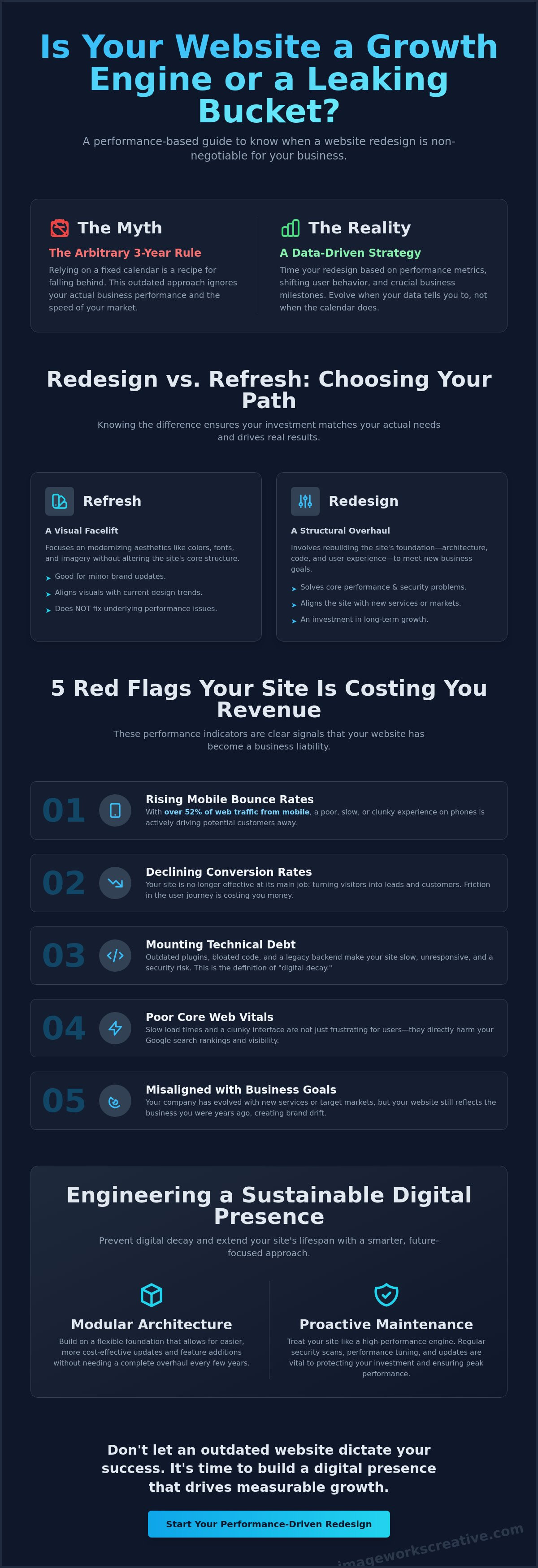
The answer isn't a static number of years; it's a strategic calculation based on performance and user behavior. With mobile devices now accounting for over 52% of global web traffic in 2026, a sluggish interface is more than an eyesore. It's a business liability. We'll show you how to identify the technical red flags that demand a full custom web design and when you can simply optimize your existing setup. This guide provides a clear framework for your next move, helping you understand the ROI of a modern build and the vital role of website maintenance plans and packages in extending your site's lifespan. You'll learn the difference between a visual facelift and a structural overhaul to ensure your investment drives actual growth.
Key Takeaways
- Stop following the arbitrary three-year rule and start timing your updates based on specific business milestones and evolving user behavior.
- Discover the data-driven indicators that answer exactly how often should a business redesign its website to protect your competitive edge in 2026.
- Learn to distinguish between a simple visual refresh and a full structural overhaul to ensure your investment matches your actual technical needs.
- Identify the five critical performance red flags, from mounting technical debt to declining conversion rates, that signal your site is losing revenue.
- Explore how modular architecture and proactive website maintenance plans and packages can extend your site's lifespan and prevent digital decay.
Beyond the Three-Year Myth: Why Timing Your Redesign Matters
The "three-year rule" is a comfort blanket for marketing departments. It's an arbitrary timeline that suggests you should tear everything down and start over every 24 to 36 months regardless of performance. In reality, the calendar is a terrible way to measure the health of your digital presence. Asking how often should a business redesign its website requires looking at your specific growth trajectory and the shifting expectations of your buyers rather than a ticking clock. A strategic redesign isn't a reactive fix for a broken site; it's a purposeful evolution of your brand's digital core.
In high-performance service industries, your digital lifespan is determined by how well your technology aligns with your sales goals. If your business has doubled in size or shifted its service offerings in the last year, your website might already be reaching the end of its effective life. Sticking to an outdated schedule while your competitors innovate creates a widening gap that's difficult to close. We view your website as a living engine of growth that needs to be tuned to the current market velocity, not a static asset that stays on a shelf for three years.
The Difference Between Aging and Obsolescence
Your website might look "fine" to the naked eye, but it can still be technically obsolete. A site built only a few years ago might lack the sophisticated mobile-first architecture or the accessibility compliance required by 2026 standards. While the visual layer is about aesthetics, the fundamentals of web design focus on the synergy between user experience and technical execution. Digital obsolescence is the gap between site capability and user demand. When your site can no longer support the fast, frictionless experience your customers expect, it has failed, even if the colors still look modern.
Market Velocity and Your Competitive Edge
Market velocity dictates your timeline. If you're in a fast-moving sector where industry leaders update their platforms every 18 months, waiting three years is a recipe for irrelevance. This lag leads to "brand drift," where the high quality of your actual services isn't reflected in your digital presence. You can mitigate this through proactive website maintenance plans and packages, but eventually, the market will demand a foundational shift. Watching how often your direct competitors refresh their messaging and UX provides a much better benchmark than any generic industry myth. Don't let a calendar dictate your competitive position when your data is telling you it's time to move.
The Science of Digital Decay: Why Websites Age Faster Than You Think
Digital decay is invisible but lethal. It starts with technical debt. Every outdated plugin and bloated line of code acts like an anchor on your performance. Over time, these small inefficiencies compound until your site feels sluggish and unresponsive. This backend erosion is a primary driver in determining how often should a business redesign its website. If your foundation is built on legacy systems from three years ago, you're likely sitting on security vulnerabilities that modern hackers exploit with ease. High-level execution requires a clean, secure base that older builds simply can't provide.
Aesthetics play a role too. Design fatigue sets in when visual trends shift. A site that looked cutting-edge in 2023 can look untrustworthy by 2026. This isn't just about fashion. It's about perceived authority. If your digital storefront looks neglected, users assume your service quality has slipped as well. Balancing these technical and visual needs is tricky. Consulting a comprehensive guide to website redesign is essential for setting a roadmap that protects your brand's integrity.
Core Web Vitals and Performance Standards in 2026
Google's March 2026 Core Update proved that technical UX is now inseparable from content quality. It's no longer enough to have the right keywords. Your site must load instantly. Slow load times on mobile devices are conversion killers for professional services. Older frameworks often struggle to meet these strict speed and accessibility requirements because they weren't engineered for the current level of efficiency. If your site doesn't pass the latest Core Web Vitals, your rankings will suffer regardless of your content.
The Shift Toward AI-Driven Search and Discovery
Search has changed. AI search engines now crawl your site to understand your expertise through structured data and clean hierarchy. Legacy sites often lack the modern schema necessary for "search generative experiences." If your architecture is messy, AI bots won't index your content correctly. You need a site built for discovery, which often requires a comprehensive SEO strategy to stay visible in an AI-first world.
Mobile-First vs. Mobile-Only Thinking
Responsive design used to be the gold standard. Not anymore. Mobile devices accounted for 52.8% of global traffic in April 2026, making a mobile-first approach the bare minimum. High-growth firms now prioritize touch-optimized interfaces and frictionless navigation as the baseline. Mobile users in 2026 expect app-like speed from standard websites. If your mobile experience feels like a cramped version of your desktop site, you're losing more than half of your potential audience. It might be time to evaluate your current digital impact and see where decay has taken hold.
Redesign vs. Refresh: Choosing the Right Strategic Path
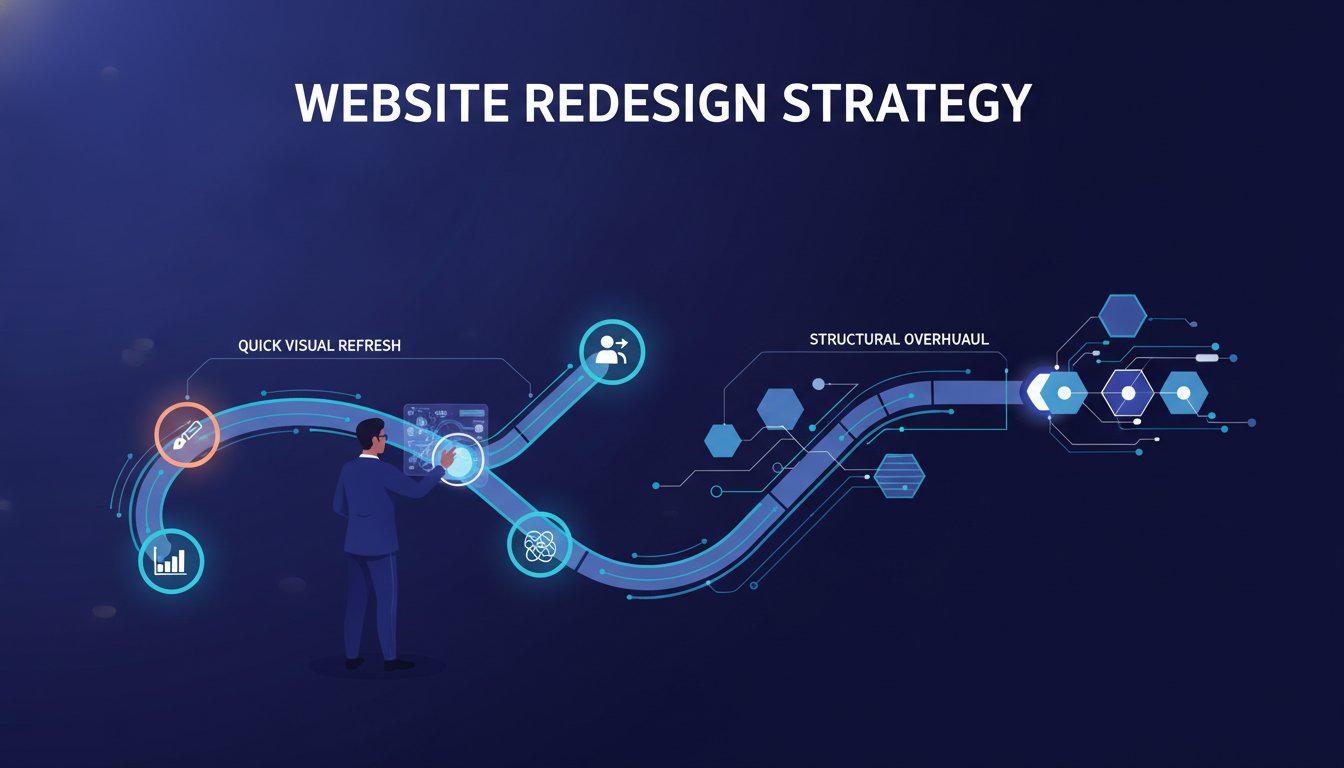
Choosing between a visual refresh and a full strategic redesign is one of the most critical decisions a marketing leader faces. It's the difference between applying a fresh coat of paint and rebuilding the foundation. Deciding how often should a business redesign its website often comes down to a choice between a quick fix and a deep build. A visual refresh is a high-impact, cosmetic update. It focuses on modernizing colors, fonts, and imagery to align with current brand standards. It's an excellent choice when your site's backend is performing well but the "look" has simply lost its edge.
Contrast this with a strategic redesign. This is a foundational overhaul of your site's architecture, user experience, and core messaging. We view a redesign as a purposeful realignment of your digital presence with your evolving business goals. While a refresh offers immediate aesthetic appeal, a redesign delivers long-term ROI by fixing broken conversion funnels and streamlining the buyer's journey. When your underlying business problems—like high bounce rates or poor lead quality—can't be solved with a new color palette, custom website design services become a strategic necessity rather than an optional upgrade.
When a Visual Refresh is Enough
There are scenarios where your technical foundation is rock solid, but your brand identity has evolved. Maybe you've recently updated your logo or shifted your brand voice. In these cases, a visual refresh can bridge the gap without the cost of a full rebuild. It allows you to stay current with 2026 design trends while keeping your existing, high-performing site structure intact. However, keep in mind that cosmetic changes have a ceiling. If your conversion rates are fundamentally broken, a new font won't fix the friction your users are experiencing.
When a Full Redesign is Non-Negotiable
When your CMS starts fighting your marketing team, a full redesign is no longer optional. Legacy systems often become rigid, making it nearly impossible to launch new service lines or landing pages quickly. This technical friction stifles growth. A structural shift is also required if you're entering new target industries that demand a different user flow or more sophisticated interactive elements. Partnering with an expert wordpress development agency is vital during this transition. They ensure your data remains secure and your SEO rankings stay protected while migrating from a legacy platform to a modern, modular architecture that's built for the future.
The Performance Audit: 5 Indicators Your Site is Costing You Revenue
Data doesn't lie. If you're questioning how often should a business redesign its website, stop looking at the calendar and start looking at your balance sheet. A site that functioned perfectly two years ago might be a massive revenue leak today. We view a website as a precision tool. When that tool loses its edge, your lead quality drops and your sales team spends more time chasing "bad traffic" than closing deals. A performance audit reveals the friction points that are invisible to the naked eye but obvious to your bottom line.
To determine if your digital presence is still an asset, evaluate these five critical indicators:
- Conversion Rate Trends: Analyze your data over the last 12-18 months. A steady decline usually points to a breakdown in user experience.
- Ease of Management: If your marketing team needs a developer to change a headline or swap an image, your technical debt is stifling your agility.
- Mobile Journey Friction: With mobile devices accounting for 52.8% of global web traffic as of April 2026, any mobile navigation hurdle is a direct hit to your revenue.
- Messaging Alignment: Does your site reflect your 2026 business goals, or is it still talking about services you've outgrown?
- Competitive Visibility: Audit your organic rankings. If newer, more agile competitors are outranking you, your site's architecture is likely the culprit.
Lead Quality and Conversion Friction
There's a massive difference between "bad traffic" and a "bad landing page." You might be driving the right people to your site, but outdated forms, confusing navigation, and slow load times kill high-intent leads before they can convert. A modern approach focuses on landing page design and optimization to remove every ounce of friction from the buyer's journey. If your current structure makes it hard for people to give you their information, you aren't just losing a lead; you're handing it to a competitor.
The "Invisible" Loss: Technical SEO Decay
Technical SEO decay is a slow, silent killer. Hidden errors, broken links, and poor site maps lead to a gradual decline in search rankings that's hard to reverse without a total overhaul. This is where professional seo services become invaluable. They help you identify when your site's structure is so outdated that a redesign is the only way to recover your visibility. A site that ranks well today might be invisible by next year if it doesn't meet the latest search engine requirements. It's time to audit your performance and see where your revenue is leaking.
Engineering for the Future: Building a Sustainable Digital Presence
Building a website that lasts isn't about luck. It's about engineering. When considering how often should a business redesign its website, the goal should be to shift from a cycle of total destruction to one of continuous evolution. Modular design is the key. By using a component-based architecture, you can update specific sections of your site as technology shifts without needing to rebuild the entire foundation. This approach ensures your digital presence remains agile and responsive to the 2026 market, where user expectations change overnight.
Sustainability also requires a proactive website maintenance plan. Think of it as an insurance policy for your competitive edge. Regular updates to security protocols, CMS cores, and plugin synergies prevent the technical decay we explored in previous sections. In 2026, the shift toward AI-integrated search and privacy-first user experiences means your site must be constantly fine-tuned. We integrate data-driven feedback loops into every build. This allows us to make incremental improvements based on how your actual users interact with your brand post-launch, extending the effective lifespan of your investment.
The Synergy of Design and Strategy
A successful build requires more than just code. It requires a deep understanding of your business model. Our collaborative approach ensures your site serves your sales team just as effectively as it serves your IT department. We bring seasoned expertise to specialized sectors like medical, legal, and technology, where the stakes for trust and authority are high. Bespoke solutions consistently outperform generic templates in these professional service markets because they are engineered to meet the unique demands of your specific audience. It's about creating a unified digital unit where design and strategy function as one.
Taking the Next Step Toward Your 2026 Redesign
Don't wait for a total system failure to act. The first step is a professional audit to determine your site's actual health relative to 2026 technical standards and AI-first search requirements. We'll help you prepare your team for a collaborative process that focuses on measurable growth and high-level execution. If you're ready to stop reacting to the calendar and start leading your industry, we invite you to explore ImageWorks Creative’s custom solutions. Let’s build a digital presence that doesn't just look exceptional but works tirelessly to grow your brand.
Stop Counting Years and Start Measuring Impact
Your website is a living engine for growth, not a static monument. We've seen that the arbitrary three-year cycle is a myth that often leads to missed opportunities and revenue leaks. Success in 2026 depends on your ability to recognize the subtle signs of digital decay and respond with strategic precision. Whether you need a focused visual refresh or a foundational overhaul, the decision of how often should a business redesign its website must be rooted in your actual performance data and competitive velocity.
At ImageWorks Creative, we've been delivering award-winning design since 1997. Our team brings specialized expertise to the medical, legal, and tech sectors, using a data-driven collaborative process to ensure your digital presence is a high-level creation. We don't just build sites; we engineer long-term growth through synergy and technical excellence. It's time to move beyond templates and invest in a bespoke solution that works as hard as you do. Partner with ImageWorks Creative to engineer your next high-performance website and protect your competitive edge for years to come. Your next level of success is just one strategic move away.
Frequently Asked Questions
How much does a professional business website redesign cost in 2026?
Professional redesign costs scale with the complexity and size of your site. Industry data for 2026 suggests that a small business site with 5 to 15 pages typically ranges from $2,000 to $10,000. Mid-size businesses with 20 to 75 pages often see ranges between $8,000 and $30,000 for custom development and content migration. These figures represent industry averages for high-quality, mobile-responsive builds that include modern SEO integration and CMS functionality.
Will a website redesign hurt my current SEO rankings?
A redesign only hurts your rankings if it's executed without a technical migration plan. When you maintain a clean URL structure and use 301 redirects properly, you preserve your existing link equity. In fact, most firms see a ranking boost after a redesign because they finally resolve technical debt and slow load times. Aligning your new architecture with a comprehensive SEO strategy is the best way to ensure long-term visibility.
How long does a typical redesign process take for a service-based business?
A standard redesign for a service-oriented firm usually takes between 8 and 14 weeks. This timeframe allows for a deep discovery phase, strategic messaging, custom design mocks, and full technical development. While it's possible to rush a template build, a bespoke solution that truly reflects your brand's authority requires a collaborative rhythm. Larger sites with extensive service sections or complex integrations may move closer to the 16-week mark to ensure every detail is perfect.
Can I redesign my website in stages to avoid a massive upfront cost?
Yes, many high-growth firms use a phased approach called Growth-Driven Design. You start by launching a high-performing "launchpad" site that features your most critical pages and functions. From there, you use real-time user data to build out secondary sections and advanced features in monthly sprints. This strategy answers the question of how often should a business redesign its website by turning a one-time project into a manageable, continuous evolution of your digital brand.
What is the biggest mistake businesses make during a redesign?
The most frequent error is focusing entirely on aesthetics while ignoring the user's journey and technical performance. A site can look stunning but still fail if the navigation is confusing or the mobile load speed is sluggish. With mobile devices accounting for over 52% of traffic in 2026, failing to prioritize a touch-optimized interface is a recipe for high bounce rates. Always lead with strategy and UX before you fall in love with a specific visual style.
How do I know if I need a new CMS or just a new design?
You need a new CMS if your current backend feels like a bottleneck for your marketing team. If simple content updates require a developer or if your site lacks the modular flexibility needed for modern SEO, the problem is structural. A visual refresh is fine for a solid foundation, but technical obsolescence requires a custom web design build. Don't build a modern house on a crumbling foundation.
Should I redesign my logo at the same time as my website?
Redesigning your logo alongside your website is often the most cost-effective way to ensure brand synergy. Your website is the primary touchpoint for your visual identity, so launching both simultaneously creates a unified and powerful first impression. If your current logo feels dated or doesn't represent your 2026 business goals, it's the perfect time to update your brand identity. This collaborative approach ensures your colors, fonts, and icons function as a single, cohesive unit.