Call or text us! (703) 928-7309
How to Calculate the ROI of a Website Redesign: A Strategic Guide for 2026

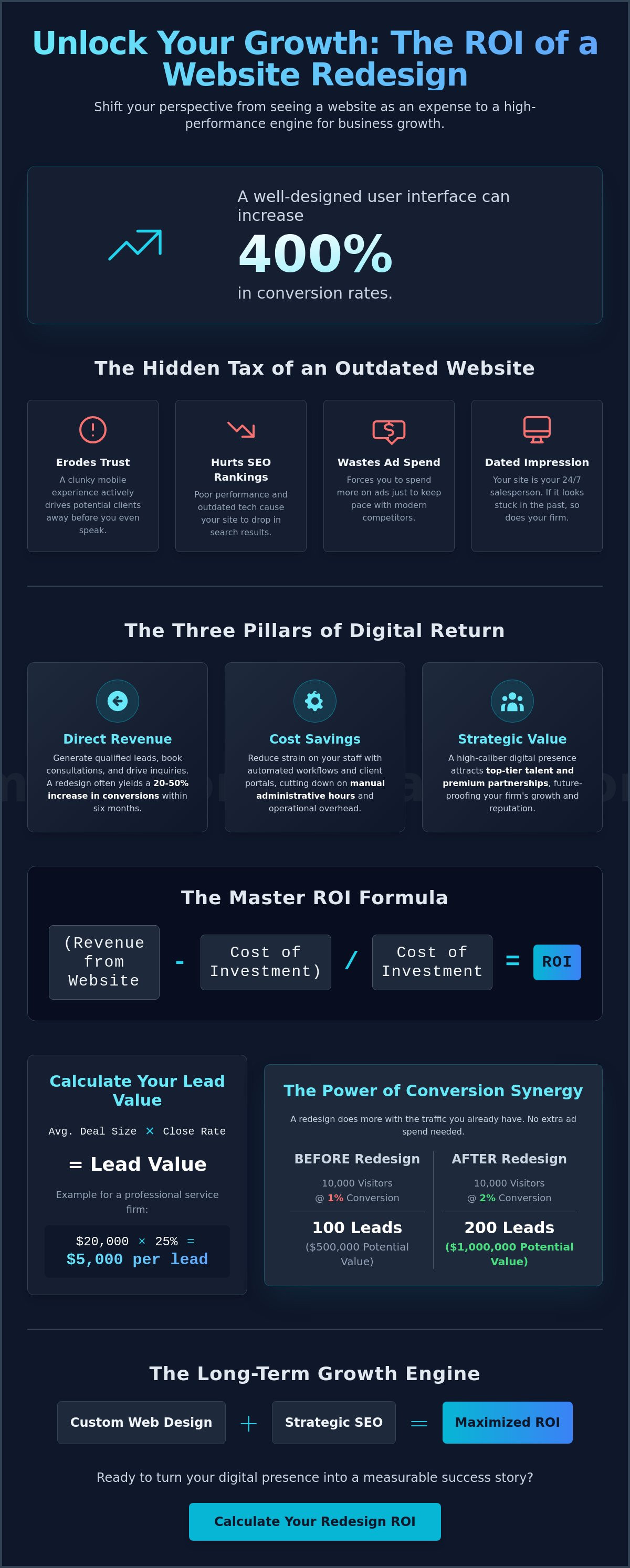
A well-designed user interface can increase conversion rates by up to 400 percent, yet many leadership teams still treat a digital overhaul as an expense to be minimized rather than a strategic asset. If you're struggling to bridge the gap between aesthetic appeal and bottom-line results, you aren't alone. Learning how to calculate roi of a website redesign is about more than just basic math; it's about proving that custom web design is a high-performance engine for your business growth.
You already know that an outdated site costs you credibility and leads every single day. We understand the pressure to show immediate results while justifying the value of a bespoke build over a generic template. This guide provides the mathematical formulas and strategic framework you need to present a bulletproof case to your board. We'll explore how to value your leads, measure the impact of search engine optimization, and determine the exact payback period for your investment. From long-term growth metrics to website maintenance plans and packages that protect your gains, you're about to turn your digital presence into a measurable success story.
Key Takeaways
- Shift your perspective from viewing a digital build as a static expense to seeing it as a high-performance engine for lead generation.
- Master the specific mathematical formula for how to calculate roi of a website redesign so you can confidently present projected growth to your executive board.
- Identify the intangible benefits of brand identity design that drive tangible trust and higher close rates for professional service firms.
- Establish a clear baseline for success by auditing your current traffic and calculating your precise cost per acquisition before the project begins.
- Learn how integrating search engine optimization with custom development creates the technical synergy needed to maximize your total return.
Defining Website Redesign ROI for Professional Service Firms
ROI is often misunderstood as a simple subtraction problem. In reality, it represents the total value your digital asset generates compared to the capital required to build and sustain it. For firms in the B2B and professional services sectors, this calculation looks very different than it does for a retail shop. You aren't just selling a $50 widget; you're selling expertise, trust, and high-value contracts that can span years. This requires a sophisticated lens that accounts for long sales cycles and high-touch relationships.
Understanding how to calculate roi of a website redesign requires looking past the immediate "buy" button. While e-commerce sites track instant transactions, a law firm, medical practice, or tech consultancy must track the entire lifecycle of a lead. Your website functions as your most consistent, 24/7 sales representative. It never sleeps, it never goes off-script, and it often provides the first impression a potential client has of your firm. If that representative looks like they're stuck in 2015, the conversation usually ends before it begins. A modern build bridges the gap between initial curiosity and a signed contract.
The Three Pillars of Digital Return
A truly high-performing site delivers value across three distinct areas that compound over time:
- Direct Revenue: This is the most visible metric. It includes qualified leads, consultation bookings, and direct inquiries. A well-executed redesign often yields a 20-50% increase in conversions within the first six months.
- Cost Savings: Modern builds reduce the strain on your staff. By using website maintenance and hosting services that include automated workflows or comprehensive client portals, you cut down on manual administrative time.
- Strategic Value: This is about your firm's future. A high-caliber site attracts top-tier talent and premium partnership opportunities that wouldn't give a dated site a second glance.
The High Cost of Digital Inaction
Sticking with a "good enough" website carries a hidden reputation tax. In 2026, prospects make snap judgments. Research shows a well-designed user interface can increase conversion rates by up to 400 percent. Conversely, a clunky mobile experience actively erodes trust before you ever get a chance to speak. You're also paying more for your visibility. If your landing pages aren't optimized for modern performance standards, your SEO and search rankings will suffer. This forces you to spend more on expensive ads just to keep pace with competitors. Inaction isn't a neutral choice. It's a slow leak in your marketing budget that compounds every month you wait.
The Master Formula: Calculating Quantitative Return
The mathematical foundation for how to calculate roi of a website redesign begins with a direct equation: (Total Revenue from Website - Cost of Investment) / Cost of Investment. While the formula is simple, the variables inside it are where most professional firms find their true value. For a service-based business, your "revenue" isn't a single transaction in a shopping cart. It's the cumulative value of every qualified inquiry that your digital presence captures and nurtures.
Your total cost of investment must go beyond the initial design invoice. You have to include website maintenance plans and packages, content production, and the internal hours your team spends on the project. Once you have a clear cost baseline, you can determine your Lead Value. This is calculated by multiplying your Average Deal Size by your sales team's Close Rate. If a typical contract is worth $20,000 and you close 25 percent of your inquiries, every web lead has a concrete value of $5,000.
Variable 1: Lead Volume and Conversion Rate Synergy
Conversion rate synergy is the powerful interaction between high-end user experience and visitor intent. Instead of pouring more money into expensive ads to buy more traffic, a redesign focuses on doing more with the visitors you already have. Let's look at the math. If your site attracts 10,000 monthly visitors with a 1 percent conversion rate, you generate 100 leads. A strategic custom web design can often lift that rate by 20 to 50 percent within six months. Moving from a 1 percent to a 1.5 percent conversion rate gives you 50 extra leads every month without increasing your ad spend. This efficiency is the fastest way to shorten your payback period.
Variable 2: Average Contract Value (ACV)
High-caliber design does more than just look professional; it acts as a strategic filter. A sophisticated site for B2B professional services attracts clients with larger budgets and more complex needs. Think of a specialized medical practice or a law firm. A generic, dated site often attracts price-shoppers looking for the lowest cost. A bespoke, authoritative site attracts premium clients who value expertise and results. By elevating your brand positioning, you naturally increase your Average Contract Value.
This shift in lead quality is why Customer Lifetime Value (CLV) is so critical to your ROI. A single high-quality client won't just pay one invoice. They might stay with your firm for years, providing recurring revenue that dwarfs the initial cost of the build. When you factor in this long-term growth, the redesign moves from a one-time expense to a permanent revenue multiplier. If you're ready to see how these numbers apply to your specific goals, let's analyze your current metrics and project your potential return.
Beyond the Numbers: Measuring Qualitative and Strategic ROI
Math tells a vital part of the story, but it doesn't capture the full strategic weight of a digital transformation. When you look at how to calculate roi of a website redesign, you have to account for assets that don't always show up on a spreadsheet but definitely show up in your bank account. These include your firm's reputation, its ability to attract elite talent, and its resilience against legal or security risks. In 2026, accessibility is a prime example. An ADA-compliant site isn't just about avoiding litigation; it expands your reachable market by serving the roughly 25 percent of adults who live with a disability. This turns a compliance requirement into a clear growth opportunity.
Brand Equity as a Revenue Multiplier
Professional brand identity design functions as a silent closer. It establishes instant authority, allowing your firm to command higher fees without the friction of a long, defensive sales cycle. When your digital presence matches the caliber of your service, trust is built before the first meeting ever happens. This synergy between aesthetics and strategy shortens the path from prospect to partner. It's the difference between being viewed as a replaceable vendor and being respected as an essential industry leader. High-end design creates a premium perception that justifies premium pricing.
Internal impact is equally significant. A fast, secure, and beautiful site significantly boosts team morale. Your employees want to share a site they're proud of. Beyond that, top-tier professionals want to work for firms that look like they're winning. A modern site lowers your recruitment costs by acting as a powerful employer branding tool, attracting the kind of talent that drives long-term profitability.
Technical Performance and SEO Longevity
Technical proficiency is a long-term investment in cost reduction. By prioritizing search engine optimization and Core Web Vitals, you build organic visibility that persists long after an ad campaign ends. This reduces your reliance on perpetual PPC spend. Site speed directly impacts your organic rankings in 2026, ensuring you stay ahead of competitors who neglect their technical debt. Additionally, investing in secure hosting prevents the devastating negative ROI of a data breach. A single security failure can wipe out years of brand equity; proactive maintenance is the ultimate insurance policy for your digital investment.
A Step-by-Step Framework for Your Redesign ROI Projection
Moving from the conceptual value of brand equity to a concrete projection requires a disciplined approach. You can't improve what you don't measure. Understanding how to calculate roi of a website redesign begins with establishing a rigorous baseline. This allows you to stop guessing and start projecting with the confidence of an industry veteran. By following a structured framework, you turn your digital presence into a predictable revenue driver.
- Step 1: Audit your current baseline metrics, including monthly traffic, lead conversion rates, and lead quality.
- Step 2: Calculate your current Cost Per Acquisition (CPA) to understand what you're currently paying for every new client.
- Step 3: Define your redesign goals, such as a 20 percent lift in inquiries and 15 percent faster load times.
- Step 4: Estimate the "synergy lift" that occurs when high-end custom web design and technical SEO work together.
- Step 5: Compare your projected three-year revenue against the one-time build cost to see the true long-term gain.
Benchmarking Your Baseline
Google Analytics 4 is your primary tool for finding "money pages," those specific URLs that drive the most valuable interactions. Data tells you what is happening; it doesn't always explain why. You need to identify "leaky" spots where potential clients drop off. A professional UX optimization audit reveals these hidden friction points. Fixing a broken user journey often leads to a significant conversion lift without needing to increase your traffic volume.
Projecting the Payback Period
When will your investment pay for itself? For B2B professional services, a 12 to 18 month horizon is the standard break-even point. This timeline accounts for longer sales cycles and the time needed for technical SEO improvements to take full effect. You should also include your website maintenance plans and packages in this long-term view. These ongoing costs ensure your site remains secure and fast, protecting your ROI for years to come. If you're ready to build your own projection, let’s analyze your current performance and map out your path to growth.
Maximizing Synergy: How ImageWorks Creative Guarantees Long-Term Results
We don't believe in isolated digital components. A website isn't just a collection of pages; it's a unified engine where creative strategy and technical precision must work in perfect harmony. At ImageWorks Creative, our synergy-first approach ensures that your brand identity, user experience, and technical performance are engineered as a single unit from day one. This integration is vital because it prevents ROI dilution. When design and search engine optimization are treated as separate phases, you often end up with a beautiful site that nobody can find, or a visible site that nobody trusts. We solve both problems simultaneously.
Choosing a proactive partner over a one-off vendor is the most important decision you'll make when considering how to calculate roi of a website redesign. A vendor delivers a file and walks away. A partner stays deeply integrated into your success, ensuring your site evolves alongside your business goals. Our bespoke WordPress builds offer a level of performance and longevity that cheap templates simply can't match. While a template might save money upfront, its hidden costs in slow load times and limited flexibility will eventually drag down your conversion rates and increase your long-term expenses.
Bespoke Solutions for High-Stakes Industries
We've spent decades tailoring ROI strategies for firms in the medical, legal, and tech sectors. These high-stakes industries require more than just a pretty layout. They demand rigorous ADA compliance and secure hosting to protect both the firm and its clients. Since 1997, our award-winning team has navigated the evolution of digital platforms, providing a level of seasoned expertise that helps our clients avoid common pitfalls. For B2B professional services, this stability is a trust signal that translates directly into higher-quality leads and more closed deals.
Ready to Engineer Your Growth?
In 2026, data-driven design is the only way to stay competitive. You've seen the formulas and you understand the qualitative multipliers that a custom build provides. Now, it's time to apply those insights to your own firm. We invite you to a strategy consultation where we can look at your current metrics and project your specific potential for return. Don't leave your digital growth to chance when you can engineer it for success. Contact us today for a custom website strategy and let's start building a digital asset that pays dividends for years to come.
Secure Your Firm's Digital Future
You now have the strategic framework to prove that a website is a high-performance investment rather than a recurring expense. By mastering how to calculate roi of a website redesign, you can align your creative ambition with your board's financial goals. Success in 2026 requires a balance of hard data, like lead value and close rates, and qualitative multipliers like brand authority and accessibility. When these elements function as a single unit, your digital presence becomes an unstoppable growth engine.
Since 1997, ImageWorks Creative has served as a proactive partner for high-stakes firms in the legal, medical, and tech sectors. We're award-winning WordPress experts who specialize in building bespoke solutions that protect your reputation and your bottom line. Don't leave your firm's growth to chance or generic templates. It's time to engineer a site that reflects your true expertise and delivers a predictable return.
Request a Website Strategy Consultation today to analyze your current metrics and project your firm's potential. We're ready to help you lead your industry.
Frequently Asked Questions
How long does it typically take to see ROI from a website redesign?
Most businesses reach a break-even point within 4 to 14 months after their new site goes live. This timeline depends on your specific industry and the scale of the strategic changes you've implemented. A well-executed project often delivers a conversion lift of 20 to 50 percent within the first six months. This rapid improvement helps shorten the payback period for firms that prioritize high-intent user journeys.
Can I calculate ROI if I don’t sell products directly on my website?
You can absolutely measure financial returns for service-based sites by assigning a monetary value to every qualified inquiry. Use your average deal size and sales close rate to determine exactly what a single web lead is worth to your firm. This data-driven method is the most accurate way for professional service firms to understand how to calculate roi of a website redesign when direct online transactions aren't the goal.
What is the "Cost of Inaction" in a website redesign context?
The cost of inaction is the measurable revenue your firm loses every month by maintaining a site that converts below modern industry standards. If your current site converts at 1 percent while a custom web design could reach 2 percent, you're effectively losing half of your potential leads. You're also paying a "reputation tax" that makes every other marketing dollar you spend less effective over time.
How does SEO impact the overall ROI of a new website?
High-performance search engine optimization lowers your long-term acquisition costs by building organic equity that persists without a daily ad budget. By establishing search authority, your site continues to attract qualified prospects long after the initial build is complete. This creates a compounding effect where your cost per lead drops significantly, boosting your total return compared to sites that rely solely on paid traffic.
Is a custom WordPress site a better ROI than a template?
A bespoke custom web design built on WordPress typically offers a superior return because it's engineered for speed, security, and conversion. Templates often carry heavy, unnecessary code that slows your load times and hurts your search rankings. Custom builds allow for precise strategic engineering; they ensure your site can scale with your business and avoid the technical debt that plagues off-the-shelf software solutions.
What metrics should I present to my board to justify a redesign?
Focus your presentation on high-level business outcomes like projected conversion rate lift, total lead value, and the estimated payback period. Boards want to see how the investment moves the needle on revenue and operational efficiency. Presenting a clear 90-day post-launch measurement plan shows that you're treating the redesign as a strategic asset rather than just an aesthetic update to the firm's digital presence.
How do branding and logo design contribute to website ROI?
Professional brand identity design acts as a trust multiplier that shortens your sales cycle by establishing instant credibility. When your visual style matches the caliber of your expertise, prospects feel more confident in their decision to contact you. This perceived authority allows your firm to command higher fees and reduces the friction your sales team faces when closing high-ticket contracts with premium clients.
What happens to my ROI if I don’t invest in website maintenance?
Neglecting website maintenance plans and packages leads to a rapid decay in your site's performance, security, and search visibility. Without regular updates, your site becomes vulnerable to technical errors and security breaches that frustrate users and tank your conversion rates. Consistent upkeep is the only way to protect your initial investment and ensure your digital asset continues to deliver a positive return for years.