How to Measure Marketing Success: The 2026 Strategic Framework

Most marketing dashboards are just expensive digital wallpaper. You've likely felt the sting of wasted ad spend on low-quality leads while your data remains trapped in disconnected silos. It's difficult to justify a budget to the C-suite when you can't prove a direct line between a click and a customer. You want more than just surface-level engagement. You need to know how to measure marketing success in a way that actually impacts your bottom line.
We agree that marketing shouldn't be a guessing game. This guide will help you master the metrics that matter and transform raw data into a clear roadmap for business growth. We'll explore the 2026 strategic framework, from building a reliable tech stack to engineering a synergistic ecosystem where custom web design, SEO, and brand identity function as a single unit. You'll walk away with the confidence to scale your investments and the clarity to align every campaign with your core business goals.
Key Takeaways
- Shift from vanity to value. Define success through high-performance growth indicators that actually move the needle for professional service firms.
- Implement a full-funnel KPI framework. Learn to track brand reach at the top of the funnel and high-intent conversions in the middle.
- Master the synergy effect. Discover how to measure marketing success by understanding how different digital channels amplify and support one another.
- Modernize your measurement engine. Conduct a comprehensive digital audit to identify data gaps and deploy a reliable tech stack for precise tracking.
- Optimize your control center. See how custom web design and strategic SEO engineering create the foundation for measurable, long-term business growth.
The Reality of Marketing Measurement: Why Vanity Metrics Fail Professional Service Firms
Many firms mistake activity for achievement. They celebrate a surge in website traffic or a viral LinkedIn post without asking if those eyeballs belong to their ideal clients. This is the "Vanity Trap." High impressions look great in a monthly report, but they rarely translate to the high-stakes partnerships professional service firms rely on. Real growth requires a shift in perspective. You must stop viewing marketing as a cost center and start treating it as a precision-engineered revenue driver.
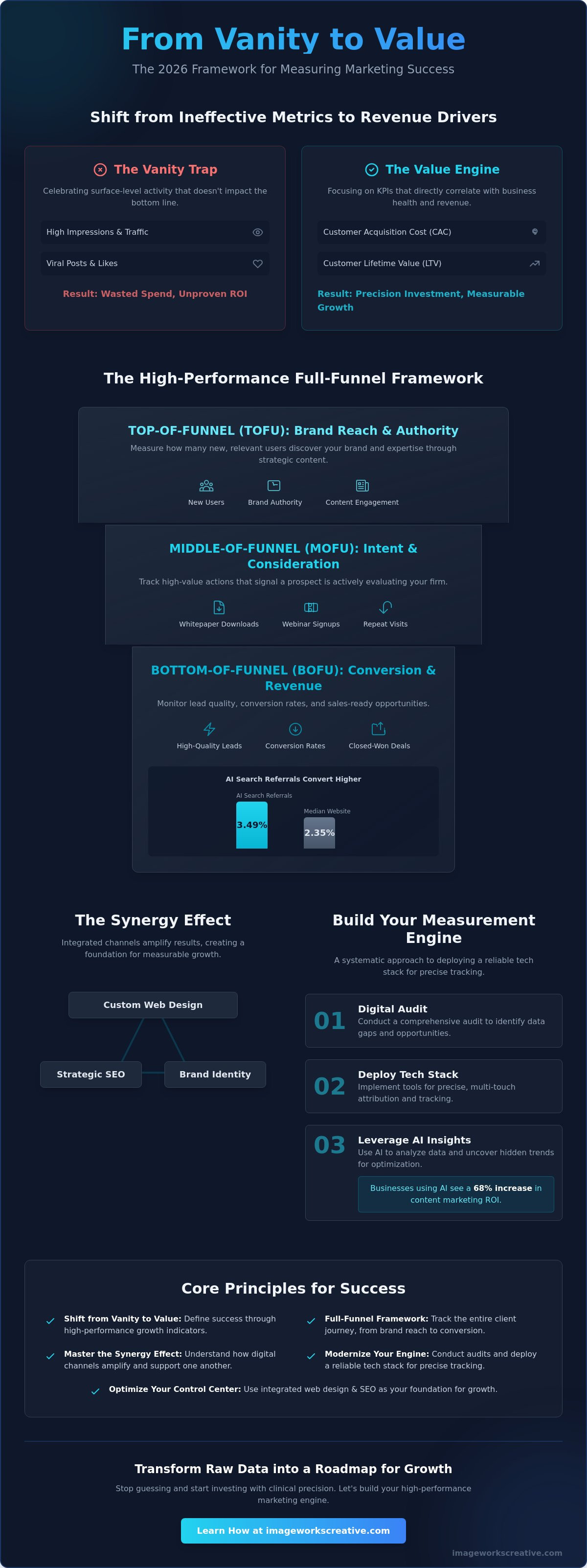
Learning how to measure marketing success starts with defining your "North Star" metrics. These aren't surface-level numbers. They are the KPIs that directly correlate with business health, such as Customer Acquisition Cost (CAC) and Lifetime Value (LTV). By focusing on marketing effectiveness, you move beyond the noise of clicks and likes to understand the causal impact of your efforts. In a world where businesses using AI have seen a 68% increase in their content marketing ROI, your measurement strategy must be as sophisticated as the tools you deploy.
The High Cost of Invisible Marketing
Unmeasured campaigns are more than just a missed opportunity. They are a drain on your firm's resources. Without clear data, budget leakage becomes inevitable. You end up pouring money into channels that feel productive but fail to deliver quality leads. The psychological toll is equally heavy. Leaders often feel they're "guessing" rather than leading; this erodes confidence in scaling investments. Unlike e-commerce, where a sale happens in a single click, professional services involve complex, multi-touch journeys. Your tracking must be nuanced enough to follow a prospect from their first interaction with a blog post to the final signed contract.
Defining Success Before the Launch
You can't measure progress without a starting point. Establishing a baseline is the first step toward accountability. We believe in building a foundation of collaborative enthusiasm where your marketing objectives align perfectly with your long-term corporate vision. This isn't just about setting numbers. It's about ensuring every team member understands how a specific campaign supports the larger goal. When 88% of consumers state that the experience a company provides is as important as its products, your KPIs must reflect the quality of those interactions. Setting these benchmarks early ensures that every dollar spent on PPC Management or Search Engine Optimization (SEO) is an intentional step toward measurable growth.
Defining the Right KPIs: A Full-Funnel Framework for 2026
A marketing funnel isn't just a theoretical shape. It's a living roadmap of the client journey. Understanding how to measure marketing success requires a granular look at the entire journey, from the first spark of awareness to the final signature on a contract. In 2026, the standard for performance has evolved. We no longer look at isolated metrics; we look at the synergy between every touchpoint.
To build a high-performance engine, you must track specific KPIs at every stage:
- Top-of-Funnel (TOFU): Focus on brand reach and authority. Measure how often your expertise is cited and how many new users discover your brand through strategic Content Marketing.
- Middle-of-Funnel (MOFU): Track intent. Look for high-value actions like whitepaper downloads, webinar signups, and repeated visits to service pages.
- Bottom-of-Funnel (BOFU): This is where the rubber meets the road. Monitor conversion rates, lead quality, and the volume of sales-ready opportunities. In 2026, the median website conversion rate is 2.35%, but traffic from AI search referrals often converts at a higher rate of 3.49%.
The Lead-to-Revenue Bridge is the final, critical link. You must connect digital actions directly to your CRM's closed-won deals. It's not enough to know a lead was generated. You need to know which specific campaign, landing page, or video production effort eventually resulted in revenue. This level of marketing analytics allows you to stop guessing and start investing with clinical precision.
Awareness vs. Intent: Not All Traffic is Equal
Quantity is a distraction. Quality of Visit is the metric that matters now. Clicks are cheap, but engagement is earned. In 2026, we use time-on-page and scroll depth as proxies for genuine interest. If a user spends four minutes reading a technical SEO guide, that's a signal of high intent. We use Search Engine Optimization (SEO) to feed the awareness engine, but we optimize for the human on the other side of the screen. Since 71% of consumers expect personalized interactions, your content must do more than rank; it must resonate.
The ROI of Brand Identity
Can you measure the value of a logo? Absolutely. A high-caliber Brand Identity Design acts as a force multiplier for all other marketing efforts. We track this through brand recall and direct search volume. When your brand is recognizable, your cost-per-acquisition (CPA) drops because trust is already established. Visual aesthetics aren't just about looking good. They are about engineering user trust. A professional, bespoke design ensures that when a prospect lands on your site, they see a partner, not just another vendor.
Attribution and Synergy: Solving the Multi-Touch Conversion Puzzle
Conversion is rarely a single event. It's the culmination of a strategic sequence. For professional service firms, a prospect might find you through an SEO-optimized blog post, see a targeted ad via PPC Management, and finally reach out after watching a high-caliber Video Production. If you only look at the last click, you ignore the entire engine that fueled the journey. Solving the multi-touch puzzle is essential for anyone learning how to measure marketing success in a fragmented digital environment.
We call this the synergy effect. Different channels don't just exist side-by-side; they amplify one another. A strong Brand Identity Design makes your social media marketing more effective, while Technical SEO ensures your custom web design is actually discoverable. When these components are engineered to function as a single unit, the result is a measurable increase in ROI that single-channel strategies simply can't match. This integrated approach turns individual tactics into a cohesive growth machine.
The current regulatory environment adds a layer of complexity with "Dark Social" and offline referrals. Private messages, Slack communities, and word-of-mouth are harder to track but carry immense weight. Relying solely on software-based tracking leaves a gap in your story. You need a framework that balances hard data with qualitative insights to justify a comprehensive, multi-channel marketing retainer. This ensures you aren't just buying clicks, but building a presence that commands attention in private professional circles.
Modern Attribution Models for Long Sales Cycles
Linear models give equal credit to every touchpoint, while time-decay models prioritize the interactions closest to the conversion. For professional services with six-month sales cycles, these models offer a more realistic view of how content marketing influences the final decision. Choosing the right model is a cornerstone of how to measure marketing success when your revenue depends on long-term relationship building. In 2026, attribution is the privacy-compliant process of assigning value to touchpoints while respecting the expanded definition of sensitive personal information under updated CCPA regulations.
Qualitative Signals: Measuring Trust and Authority
Reputation Management isn't just about damage control; it's about quantifying authority. Use sentiment analysis tools to gauge how your brand is perceived across the web. High-ticket contracts are won on trust. By tracking social proof and the impact of thought leadership, you can measure the "Trust Factor" that drives high-level creation. This qualitative data bridges the gap between a lead and a loyal partner, proving that your brand's aesthetic appeal and professional authority are working in tandem to close deals.
Building Your Measurement Engine: Audits, Tech Stacks, and AI Insights
Data silos are the enemy of clarity. If your PPC Management data lives in a different world than your CRM, you're flying blind. Realizing how to measure marketing success involves integrating these systems into a single, cohesive engine. We view this integration as a form of high-level creation where technical proficiency meets strategic ambition. Your measurement engine must be more than a collection of tools. It's a unified dashboard that provides a single version of the truth for your entire organization.
A reliable tech stack functions as the central nervous system of your firm. In 2026, this includes a robust CRM, advanced analytics, and heatmapping tools that visualize user behavior in real time. We emphasize a unified approach where these digital components are engineered to function as a single unit. This centralization moves you away from disconnected software and toward a bespoke dashboard that tells the complete story of your client's journey. When your data is unified, you gain the clarity needed to make bold, results-oriented decisions.
The 2026 Digital Marketing Audit
A comprehensive audit is the first step toward data integrity. You can't build a visionary strategy on a fractured foundation. Use this process to ensure you know how to measure marketing success with clinical precision:
- Step 1: Inventory all current tracking tags and pixels. Ensure your codes are firing correctly and aren't creating lag in your WordPress Development.
- Step 2: Check for ADA compliance and technical SEO health. Use ADA Compliance Audits to ensure your site is accessible while verifying that your technical SEO is optimized for modern search referrals.
- Step 3: Verify conversion goal accuracy. Cross-reference your analytics platform data with actual CRM closed-won deals to eliminate reporting discrepancies.
Predictive Success: The Move to Proactive Measurement
Measurement has moved from reactive to proactive. With 87% of marketers now using generative AI in their workflows, predictive analytics have become the gold standard for high-performance firms. These tools analyze historical data to forecast future marketing performance and customer lifetime value (LTV). This shift allows you to identify which accounts are most likely to convert before you even launch a campaign. Monthly strategy adjustments based on real-time AI insights ensure your budget is always flowing toward high-impact opportunities. If you're ready to modernize your tracking and eliminate data gaps, contact our team for a comprehensive measurement audit today.
Engineering Success: How Integrated Web Design and SEO Drive Measurable Growth
Web design isn't a static asset. It's the control center of your entire measurement framework. If you're struggling with how to measure marketing success, the answer often lies in your site's architecture. A site that isn't engineered for tracking is a site that leaks data. We believe in building a synergistic ecosystem where your digital presence does more than look good; it functions as a high-precision data capture tool. This integration ensures that every user action is visible, trackable, and actionable.
Landing Page Design is where your strategy meets the user's intent. By optimizing these pages for specific, trackable journeys, you eliminate the guesswork that plagues many marketing departments. When your Landing Page Design is aligned with your PPC Management and SEO efforts, you create a seamless path that's easy to monitor. This level of coordination is what separates high-performance firms from those just buying clicks. It's about engineering a journey that leads to a measurable business outcome.
Technical SEO performance is the silent driver of marketing ROI. A slow site doesn't just frustrate users; it skews your conversion data. If a page takes too long to load, the user bounces before your tracking pixel even fires. This creates a gap in your data that makes it impossible to know how to measure marketing success accurately. High-level execution in Technical SEO, a core focus for specialists like Aldin Vojic, ensures your site is fast, accessible, and ready to record every interaction. Performance is a promise of reliability that builds trust with both users and search engines alike.
Custom Web Design as a Measurement Tool
Bespoke architecture allows for granular event tracking that off-the-shelf software simply can't match. When you invest in custom website design services, you aren't just buying a look. You're building a platform tailored to your specific KPIs. This custom approach allows you to track everything from specific button clicks to complex multi-step forms. The impact of site speed and UX on your data accuracy cannot be overstated. A fast, intuitive site ensures your metrics reflect reality, not technical failures.
The ROI of a Strategic Partnership
We don't believe in the traditional vendor-client divide. We are your proactive partner, deeply integrated into your success. A data-driven approach eliminates the old conflict between creative energy and strategic goals. At ImageWorks Creative, we blend these elements into a single, high-caliber output. Our collaborative enthusiasm ensures that your brand identity, SEO, and web design function as a unified growth machine. It's time to stop guessing and start scaling. Partner with a team that takes your growth as seriously as you do. Let's start measuring what matters.
Mastering the Future of Your Marketing ROI
You now have the framework to move beyond vanity metrics and embrace a revenue-driven reality. By integrating custom web design with strategic SEO and predictive AI, you've seen how every digital component functions as a single unit. Mastering how to measure marketing success isn't just about looking at the past. It's about engineering a future where your data provides a clear roadmap for scaling. This holistic approach ensures that your brand identity and technical performance work in perfect harmony.
We've navigated the evolution of digital platforms for decades. Since 1997, ImageWorks Creative has acted as an award-winning partner for high-stakes firms in the legal, medical, and tech industries. We bring a data-driven approach to high-performance results, ensuring your creative energy is always backed by technical precision. Ready to see the real impact of your marketing? Let’s build a data-driven strategy together.
The path to business growth is no longer a mystery. With the right tools and a visionary partner, you'll transform raw data into your most valuable asset. We're excited to help you lead the way and reach your most ambitious goals.
Frequently Asked Questions
What are the most important KPIs for a professional service firm?
The most critical KPIs for professional service firms are Customer Acquisition Cost (CAC) and Lifetime Value (LTV). These metrics provide a clear picture of how to measure marketing success by focusing on long-term profitability rather than surface-level clicks. You should also track your MQL-to-SQL conversion rate to ensure your content marketing is attracting high-intent prospects. High-performance firms prioritize the lead-to-revenue bridge to justify every dollar of their marketing spend.
How long does it take to see measurable results from a new SEO strategy?
You should expect to see measurable traction within four to six months of implementing a comprehensive SEO strategy. While technical SEO fixes can provide a quicker boost in site health, building authority and ranking for competitive terms requires a sustained effort. In 2026, traffic from AI search referrals is converting at a higher rate of 3.49%, making it vital to optimize for these modern discovery channels early. Patience in the initial phase allows your synergistic ecosystem to mature and deliver consistent growth.
What is the difference between marketing effectiveness and marketing efficiency?
Marketing effectiveness measures how well your strategies achieve your core business goals, such as revenue growth or market share. Efficiency, on the other hand, focuses on the cost of achieving those results, such as your cost-per-click in PPC Management. You can be efficient without being effective if you're buying cheap clicks that never convert. We prioritize effectiveness first to ensure your brand is reaching the right audience before we fine-tune the efficiency of your campaigns.
Can I measure the success of my brand identity and logo design?
Yes, you can quantify the impact of your brand identity by tracking direct search volume and brand recall metrics. When your logo design and visual aesthetics resonate, you'll see an increase in users typing your firm's name directly into search engines. A high-caliber brand identity also reduces your cost-per-acquisition because trust is established before the first interaction. We look for these qualitative signals to prove your visual brand is acting as a force multiplier for your digital efforts.
How does a monthly marketing retainer help in measuring long-term success?
A monthly marketing retainer provides the historical baseline and consistent oversight needed to track multi-touch conversion journeys. It allows for a proactive partnership where we can adjust strategies in real-time based on AI-driven predictive analytics. Success in 2026 requires more than a "set it and forget it" mentality. Continuous monitoring ensures your tech stack remains reliable and your data stays unified, preventing the silos that often lead to wasted ad spend and missed opportunities.
What tools should I use to track my marketing ROI in 2026?
You should utilize a unified tech stack that includes Google Analytics 4 (GA4) and a robust CRM like HubSpot or Salesforce. These tools are essential for navigating a privacy-first world where third-party cookies have been deprecated. Incorporating AI-powered predictive tools helps you forecast LTV and identify high-value leads with clinical precision. Centralizing your data into a bespoke dashboard ensures your technical performance and creative output are measured as a single, cohesive unit of business growth.
How do I explain marketing metrics to a CEO who only cares about revenue?
Translate your technical data into business language by focusing on pipeline velocity and marketing-attributed revenue. When explaining how to measure marketing success to the C-suite, replace "click-through rate" with "market interest" and "conversions" with "sales-ready opportunities." Highlight how 88% of consumers state that the experience a company provides is as important as its products. This approach demonstrates that your marketing efforts are engineered to drive the bottom-line results the leadership team demands.
Why is a custom website better for tracking than a template?
Custom web design allows for granular event tracking and bespoke architecture that templates simply cannot support. With a custom site, we can engineer specific user journeys and monitor every interaction with surgical precision. This flexibility is vital for conducting ADA Compliance Audits and ensuring your technical SEO is optimized for the latest search algorithms. A custom site functions as a sophisticated measurement tool, providing accurate data that helps you scale your marketing investments with total confidence.

