Presenting a Marketing Budget to Executives: The 2026 Strategic Guide
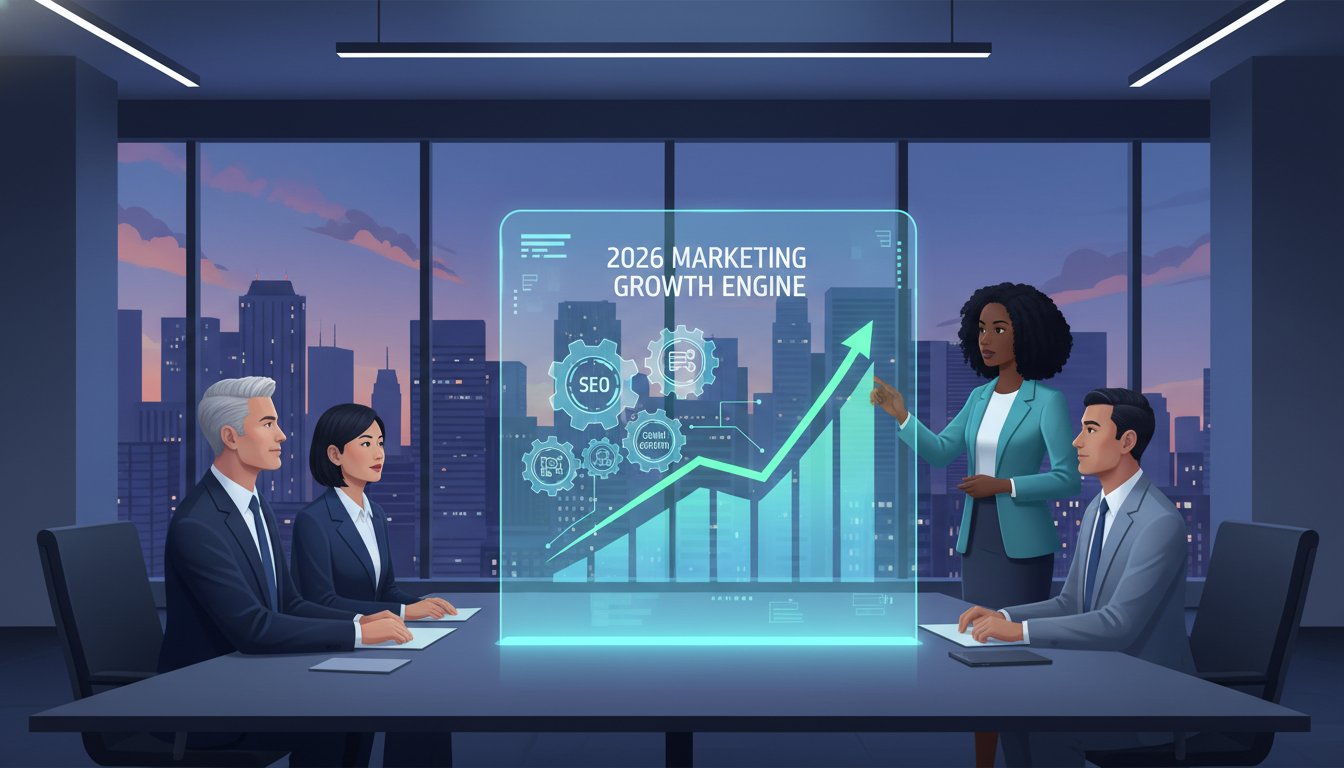
What if your marketing budget was treated as a high-yield investment portfolio rather than a recurring bill? For many leaders, the disconnect is real. Executives often view marketing as a cost center, especially when they struggle to see the direct line between bespoke brand identity design and long-term revenue growth. This makes the process of presenting a marketing budget to executives feel more like a battle for survival than a strategic planning session. You're often pushed to accept "cheap" templates when you know your brand requires a high-performance, custom solution to truly compete.
It's time to change that dynamic. We'll show you how to transform your budget from a list of expenses into a defensible growth engine that earns immediate executive buy-in. This 2026 strategic guide moves beyond simple spreadsheets. We'll explore how to align technical performance with your CEO's vision, ensuring every dollar spent on content marketing or search engine optimization is viewed as a calculated investment. You'll gain a clear roadmap for the coming year, built on synergy, transparency, and a shared ambition for exceptional results.
Key Takeaways
- Learn how to pivot your internal conversations from line-item costs to revenue engineering, ensuring leadership sees marketing as a growth driver rather than a drain.
- Master the art of presenting a marketing budget to executives by using historical performance data and conservative forecasting to build a defensible, ROI-first proposal.
- Understand the 60/40 rule and how investing in high-caliber brand identity design creates the synergy needed to lower your customer acquisition costs over time.
- Discover a high-impact framework for the boardroom that leads with business solutions and highlights the tangible cost of inaction if strategic investments are delayed.
- See how a unified approach through a full-service digital marketing agency eliminates budget waste and provides the single point of accountability executives crave.
Shifting the Narrative: From Marketing Expenses to Revenue Engineering
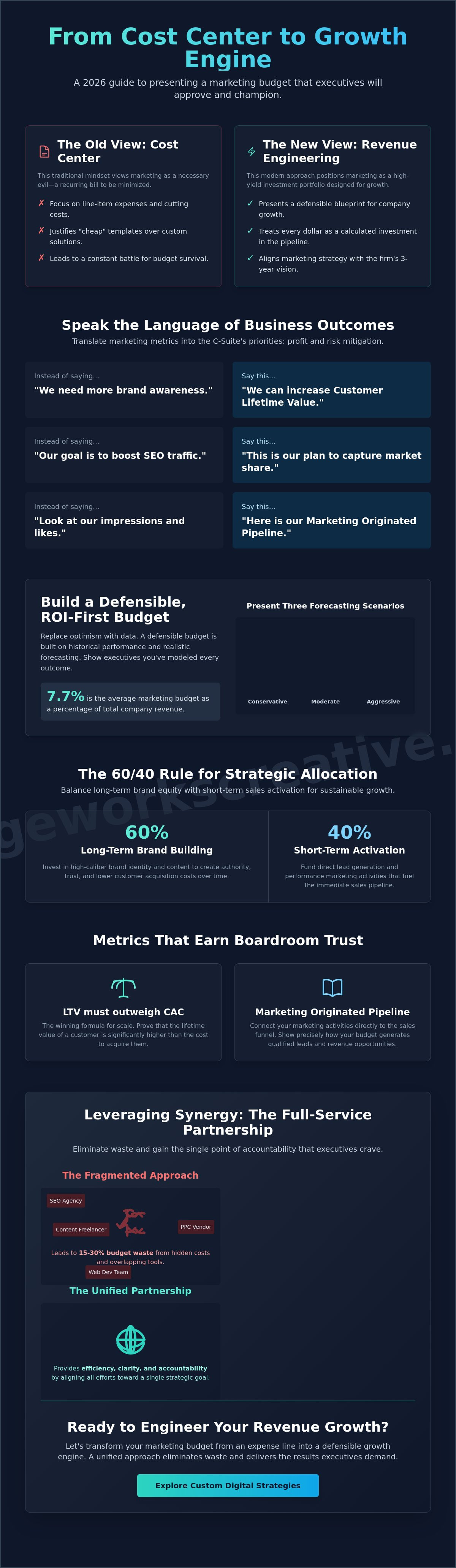
Stop thinking about your marketing budget as a bill. In 2026, the most successful firms have abandoned the "cost center" mentality. They've replaced it with revenue engineering. When you are presenting a marketing budget to executives, you aren't asking for permission to spend. You're offering a blueprint for growth. Executives don't care about the mechanics of a campaign; they care about the stability of the pipeline. If they see an expense, they look for ways to cut it. If they see a growth engine, they look for ways to fuel it.
A defensible budget aligns perfectly with the three-year corporate vision. It treats every digital component as part of a single unit. This synergy ensures that money spent on B2B professional services isn't just a disconnected add-on. It's a necessary piece of a larger puzzle. By understanding the foundational elements of a marketing plan, you can demonstrate how tactical choices support high-level business objectives. Research shows the average marketing budget is 7.7% of company revenue. However, simply hitting a percentage isn't enough. You must prove that this capital is engineered to produce a specific, predictable result.
Understanding the Executive Mindset in 2026
CEOs and CFOs are looking for two things: profit margins and risk mitigation. They don't want to hear about impressions or "likes." Those are vanity metrics that don't pay the bills. Instead, show them how your strategy protects the brand's market position. A well-structured proposal proves that you've considered the financial implications of every move. It signals that you are a proactive partner in the company's success, not just a vendor looking for a check. They want to see that you've accounted for the 15-30% of budgets often lost to hidden costs and overlapping tools.
The Language of Business Outcomes
Success in the boardroom requires a vocabulary shift. Don't talk about "SEO traffic" when you mean "market share growth." Don't say "brand awareness" when you are actually discussing "customer lifetime value." When presenting a marketing budget to executives, your request must mirror the company's primary revenue drivers. If the firm's goal is expansion, your budget should show how custom digital strategies will capture that new territory. This transition from creative jargon to business benefits is what earns trust and secures funding. It turns a difficult negotiation into a collaborative investment discussion.
Data Foundations: Building a Defensible, ROI-First Budget
Data is your foundation. Build it with precision. Before you step into the boardroom, you need a baseline rooted in reality, not optimism. Gathering historical performance data allows you to show exactly where capital was deployed and the specific results it yielded. This isn't just about looking backward. It's about setting a credible starting point for 2026. When presenting a marketing budget to executives, you must account for the specialized talent and high-end agency partnerships required to execute at a high level. High-performance growth isn't a commodity; it's a result of expert engineering.
Success requires a tiered approach. Don't just give them one number. Instead, provide three distinct forecasting scenarios: conservative, moderate, and aggressive. This demonstrates that you've modeled the impact of every dollar. It also helps you pinpoint the "break-even" point for new marketing initiatives. This is the moment your investment starts paying for itself. It's a language CFOs understand and respect. Presenting a marketing budget to executives this way transforms your request from a "spend" into a calculated business decision.
Metrics That Earn Boardroom Trust
Trust is built on specific ratios. Focus on your Customer Acquisition Cost (CAC) compared to the Customer Lifetime Value (LTV). If your LTV is significantly higher than your CAC, you have a winning formula for scale. You also need to track the Marketing Originated Pipeline. This links your activities directly to the sales funnel. To get these insights right, the synergy of ai intelligence human expertise is critical. It's how you find the most effective ways of making the most of your marketing budget while maintaining technical proficiency.
Factoring in the "Total Cost of Ownership"
Cheap solutions carry a high hidden price. "Off-the-shelf" templates save money today but often lead to technical debt and security risks tomorrow. A custom-built growth engine requires professional website maintenance and hosting services to remain stable and high-performing. Budget for continuous optimization rather than "set it and forget it" projects. This proactive approach protects your investment and ensures your brand remains competitive in a fast-moving digital landscape.
If you are ready to see how a defensible plan can scale your company, let's talk about your 2026 goals.
Strategic Allocation: Balancing Brand Authority with Lead Generation
Leads are the harvest, but brand is the soil. If you only focus on the harvest, you'll eventually exhaust the field. Most marketing leaders struggle here because they over-index on short-term performance. They chase the immediate click while ignoring the reputation that makes the click possible. A balanced strategy typically follows the 60/40 rule: 60% of your resources go toward long-term brand building, while 40% fuels direct lead generation. When presenting a marketing budget to executives, you must explain that a professional brand identity design is a financial lever, not a luxury. High brand recognition improves your ad quality scores and lowers your cost-per-click over time. It's a fundamental part of building a marketing budget for success.
Defending "invisible" budget items like SEO, UX, and technical infrastructure is often the hardest part of the boardroom pitch. Executives naturally gravitate toward "quick wins" and visible campaigns. However, a growth engine is only as strong as its foundation. If your site speed is slow or your user experience is clunky, you're essentially subsidizing your competitors' ad spend by driving frustrated users away. You need to position these technical requirements as the essential plumbing that allows your high-visibility campaigns to flow. Without them, your total ad spend efficiency drops, wasting a significant portion of your capital.
Branding as a Strategic Growth Engine
High-end branding serves as a "trust shortcut" for potential clients. In a crowded market, prospects make split-second decisions based on visual authority. This isn't just about a logo; it's about creating a competitive moat that protects your market share. When your brand carries weight, your landing pages convert at a higher rate. This synergy between creative identity and technical performance ensures that every dollar spent on promotion works twice as hard. It turns your identity into a defensible asset that competitors can't easily replicate.
The High-Performance Website as a Budget Multiplier
Your website is your only 24/7 sales representative that never asks for a raise. This is why custom website design services consistently outperform "cheap" templates in long-term ROI. A custom solution is engineered for your specific conversion goals, while templates force your business into a generic box. By optimizing for user experience and technical proficiency, you maximize the value of every visitor. A high-performance site doesn't just look better; it functions as a force multiplier for your entire marketing budget.
The Executive Pitch: A Framework for Winning Boardroom Buy-In
The pitch is where your strategy meets the reality of the boardroom. When presenting a marketing budget to executives, your delivery must be as engineered as your data. Start by leading with the business problem you are solving. Don't talk about the tools you want to buy. If the sales team is struggling with lead quality, that is your opening. Executives respond to solutions, not shopping lists. By framing your request around a specific business challenge, you immediately align your goals with theirs.
Next, present the "Cost of Inaction." This is a powerful psychological lever. Explain what happens if the budget is denied. For example, if you don't secure market share now, it will cost significantly more to reclaim it later. Use visual storytelling to simplify complex technical data. High-level charts showing PPC trends or organic growth are far more effective than dense spreadsheets. Finally, offer a "Good, Better, Best" investment model. This gives the executive team a sense of control. It moves the conversation from "Should we do this?" to "Which level of growth do we want to fund?"
Crafting the One-Page Executive Summary
Your summary is the most important document in the room. It should contain five essential elements: the business objective, the ROI forecast, the core strategy, key milestones, and the total investment. Put the ROI forecast on the very first slide. Executives want to see the bottom line immediately. Keep technical details in an appendix. If they want to dive into the weeds, the data is there, but don't let it derail your main narrative. Clear, punchy communication wins every time.
Handling Tough Questions and Objections
Expect pushback. It's part of the process. When they ask if you can do it for half the price, don't just say "no." Instead, explain which revenue targets will be sacrificed along with that funding. You must also defend the long-term value of seo services against "quick fix" alternatives that lack a solid foundation. If you get a "no," turn it into a "not yet." Identify the specific performance triggers that will reopen the conversation later in the year. This keeps the partnership alive and shows your commitment to results.
Ready to build a pitch that wins? Contact our strategy team to refine your 2026 roadmap.
Leveraging Synergy: How a Full-Service Partnership Simplifies Budget Approval
Fragmentation is the silent killer of marketing ROI. When different departments operate in silos, you lose more than just time. You lose the "Synergy Dividend." Research suggests that fragmented marketing teams waste between 20% and 30% of their budget through redundant tools, overlapping agency markups, and misaligned messaging. When presenting a marketing budget to executives, highlighting a shift toward a unified model is a powerful move. It shows you aren't just asking for more money. You're asking to spend the current capital more effectively.
A full-service digital marketing agency provides a single point of accountability. This simplifies the CFO’s life significantly. Instead of chasing five different vendors for reports, they receive consolidated billing and unified data. This transparency builds trust. It proves that every digital component is engineered to function as a single unit. A proactive partner doesn't just execute orders. They identify new growth opportunities before the board even sees them, making you look like a visionary leader rather than a tactical manager.
Consolidating for Efficiency and Performance
Managing five different "specialist" agencies carries massive hidden costs. Every meeting, every hand-off, and every disagreement between vendors drains your resources. Unified design and marketing teams accelerate your time-to-market. When the people building your brand identity are the same ones running your PPC campaigns, the execution is seamless. By using a B2B professional services framework, you can scale predictably without the friction of disjointed teams. Efficiency isn't just a buzzword. It's a competitive advantage.
Your Next Steps: Preparing for the 2026 Budget Season
Don't wait until the last minute to build your case. Start with a 30-day checklist. Spend the first ten days gathering historical data. Use the next ten to model your "Good, Better, Best" scenarios. Spend the final ten days refining your visual storytelling. A pre-budget audit is essential here to identify low-hanging fruit that can fund larger initiatives. This proactive preparation ensures that when you are presenting a marketing budget to executives, you are doing so with total confidence.
Ready to transform your marketing into a defensible growth engine? Request a strategic consultation with ImageWorks Creative to build your 2026 growth plan today.
Engineering Your 2026 Growth Engine
The boardroom doesn't have to be a place of compromise. By shifting from a cost-center mindset to revenue engineering, you position your department as a primary driver of corporate value. You now have the framework to lead with business outcomes, defend your strategy with hard data, and balance brand authority with immediate performance. This holistic approach ensures that every dollar is an investment in a predictable future rather than a shot in the dark.
When the time comes for presenting a marketing budget to executives, remember that synergy is your greatest ally. A unified strategy eliminates waste and builds the executive trust required for full funding. Since 1997, ImageWorks Creative has acted as a proactive partner for firms in the medical, legal, and tech sectors. We use a data-driven, collaborative approach to ensure your digital components function as a single, high-performance unit that delivers exceptional results.
Partner with ImageWorks Creative to engineer your 2026 growth strategy and turn your vision into a defensible reality. You have the roadmap. Now, let's build the engine together.
Frequently Asked Questions
How much of our total revenue should be spent on the marketing budget in 2026?
Aim for an average of 7.7% of total revenue, as this figure has remained a stable benchmark for successful firms. B2B companies typically allocate between 8% and 11%, while B2C brands often spend closer to 12%. If your firm is in a high-growth phase or the technology sector, you may need to push toward 15% to maintain a competitive market share against aggressive rivals.
What is the best way to justify the cost of a custom website design to a CFO?
Focus your argument on the "Total Cost of Ownership" and long-term conversion efficiency. Custom designs are engineered for superior technical performance and higher lead quality, which lowers your customer acquisition costs over time. Cheap templates often carry hidden costs in technical debt and security vulnerabilities that eventually drain more resources than a bespoke, high-performance solution would have required initially.
How do I present a marketing budget when we had poor results last year?
Own the data openly and lead with a clear analysis of the lessons learned. Executives respect transparency, so explain exactly which variables changed and how your 2026 plan corrects those specific friction points. Shifting the narrative to "revenue engineering" helps demonstrate that you are adjusting the machine for better output rather than simply repeating past tactical mistakes.
What are the most important KPIs to include in an executive marketing presentation?
Prioritize Customer Acquisition Cost (CAC), Customer Lifetime Value (LTV), and Marketing Originated Pipeline. These metrics speak the direct language of business growth that leadership craves. When presenting a marketing budget to executives, avoid vanity metrics like impressions. Instead, show how every dollar spent fuels the sales funnel and protects the company's overall profit margins.
How do I handle an executive who wants to cut the SEO budget for immediate PPC results?
Explain that PPC is a temporary rental while SEO is a long-term asset. Cutting your organic strategy for immediate ad results creates a "dependency trap" where your lead costs will never decrease. Show them that organic search compounds over time, eventually providing a much higher ROI that stabilizes the firm's digital presence regardless of fluctuating ad auction prices.
Should I include "buffer" in my marketing budget for unexpected 2026 trends?
Earmark 15% to 20% of your total budget specifically for testing and emerging technologies. This follows the 70/20/10 rule, where 10% is dedicated to high-risk, high-reward experiments. Having this strategic buffer allows you to pivot quickly when a new platform gains traction without needing to return to the boardroom for mid-year emergency funding requests.
How often should I report on budget performance to the executive team?
Deliver high-level strategic reports quarterly, supplemented by brief monthly updates on key performance indicators. Executives don't need to see every campaign tweak, but they do need to know if the budget is hitting its ROI milestones. This cadence keeps you top-of-mind as a proactive partner without overwhelming the boardroom with excessive technical data or jargon.
Can I use AI to create my marketing budget presentation?
You can certainly use AI to analyze historical data or draft an initial outline. However, presenting a marketing budget to executives requires a humanized touch and a deep understanding of your specific corporate culture. Use AI to handle the heavy lifting of data attribution, but ensure the final narrative reflects your unique brand voice and strategic ambition for the year ahead.