User-Centric Design Principles: A Strategic Framework for Business Growth in 2026

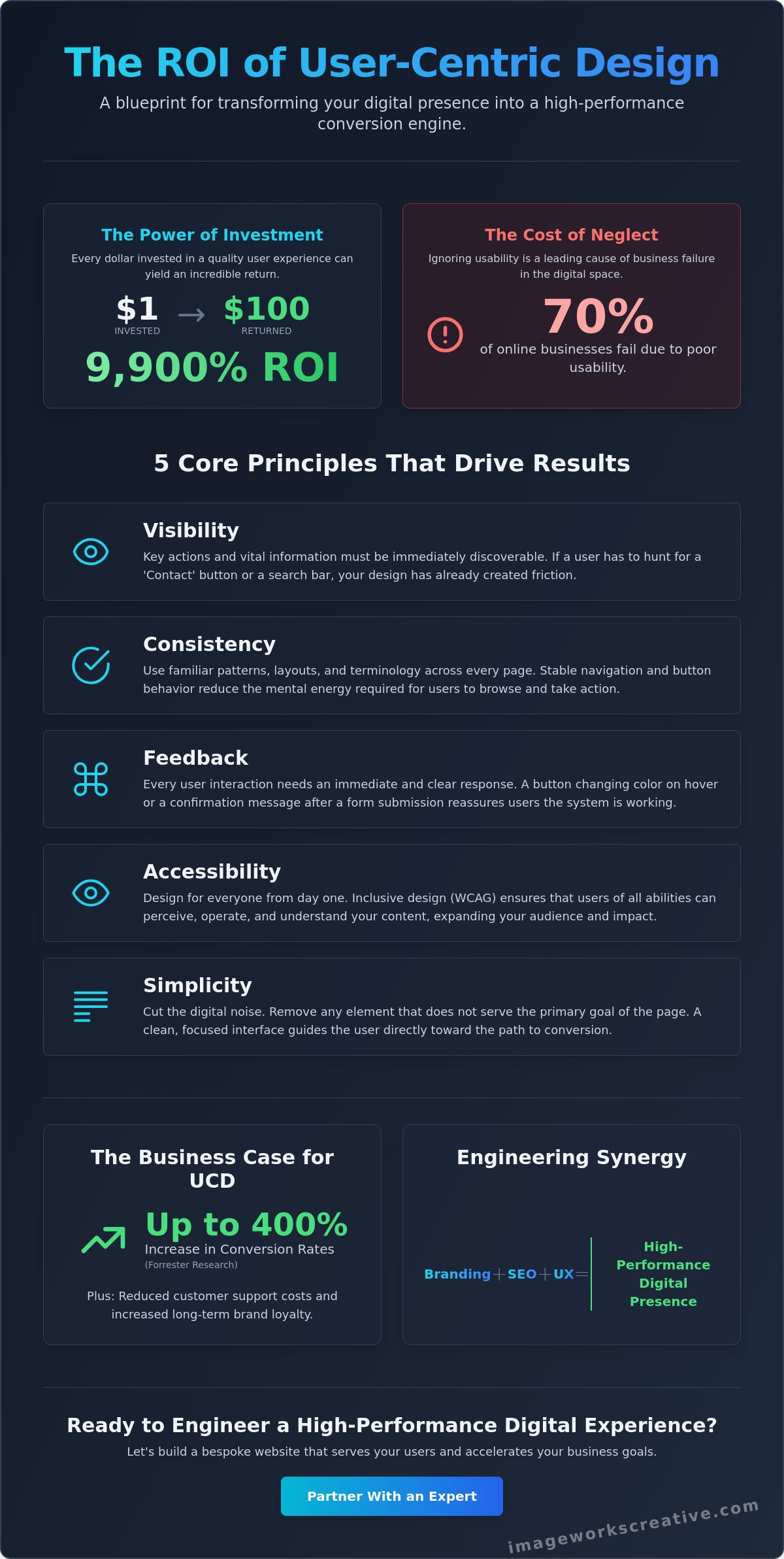
Did you know that every dollar invested in UX can return up to $100? That's a staggering 9,900% ROI that is often missed, especially since 70% of online businesses fail due to poor usability. You likely already feel the frustration of high bounce rates or the disconnect between your premium brand identity and a confusing user experience. It's exhausting to watch potential growth slip away because of technical friction or outdated layouts that don't serve your audience.
Mastering the core user-centric design principles is the key to transforming your digital presence into a high-performance engine for conversion and authority. Your website should function as a proactive partner to your users; it shouldn't be a static hurdle. This guide provides a clear, strategic framework for evaluating your site quality and implementing high-level execution that drives measurable results. We'll explore the synergy between empathy-driven research and high-performance engineering to ensure your brand stands out as a visionary leader in your industry.
Key Takeaways
- Understand why an empathy-first framework is the essential foundation for building high-performance custom websites in an increasingly competitive digital landscape.
- Learn how to apply core user-centric design principles like visibility and consistency to reduce cognitive load and guide your visitors effortlessly toward key actions.
- Discover the strategic power of the iterative lifecycle-moving from research to validation-to ensure your digital assets evolve as high-performance tools for growth.
- Identify the direct link between intuitive site navigation and increased conversion rates, alongside the long-term benefit of reduced customer support costs.
- See how engineering a synergy between branding, SEO, and user experience creates a bespoke digital presence that functions as a single, powerful unit for your business.
Defining User-Centric Design Principles for the 2026 Digital Landscape
Design is no longer just about aesthetics. It's about problem-solving through empathy. User-centered design (UCD) is an iterative framework that places the human experience at the heart of every technical decision. While ego-centric design focuses on what a business owner likes or thinks looks "impressive," true user-centric design principles prioritize the needs, behaviors, and pain points of the actual visitor. This isn't a soft science. It's the technical foundation of a high-performance custom website.
When you design for the user, you aren't sacrificing your business goals. You're accelerating them. There's a powerful synergy here. A user who finds what they need quickly is a user who converts. By aligning your digital architecture with the mental models of your audience, your site stops being a static brochure and starts being a high-performance conversion engine. We engineer these experiences to ensure that every click feels like a natural step toward a solution, turning casual visitors into brand advocates. This commitment to user-centricity should also extend to your email campaigns, where thebettercreative.com provides specialized email design and development services.
The Evolution of Design: From Function to Feeling
The digital world has moved past basic utility. In the early days, a website just had to work. Today, it has to feel right. We've transitioned from simple function to complex emotional and psychological journeys. By 2026 standards, "usability" is the bare minimum. Modern users expect intuitive anticipation. They want a site that understands their intent before they've even finished a scroll. This level of execution requires deep, data-driven insights. It means analyzing user patterns to build a site that feels bespoke to every visitor, a standard of excellence mirrored in the high-end residential and yacht projects designed by Pianta Design.
This level of bespoke quality is also essential in the physical world, where firms like Countertops and Cabinetry By Design focus on creating custom kitchen and bathroom spaces that are engineered for both beauty and user-centric functionality.
This intersection of AI innovation and physical craftsmanship is further showcased by Piece by Piece, which transforms digital photos into custom cartoon-style puzzles, creating a tangible and memorable brand experience through personalized art.
In the same vein of functional, bespoke excellence, homeowners can learn more about Nu Scape Designs to see how custom, low-maintenance landscape designs are meticulously engineered for the Southern California climate.
Furthermore, for those looking to translate these user-centric principles into their living spaces, kdb.homes provides professional home remodeling and construction services that prioritize the unique needs and lifestyles of homeowners.
In the same spirit of high-level execution, NOORICO provides a specialized design-build approach for custom homes in the Toronto area, ensuring that every architectural detail is meticulously engineered to reflect the user's vision and standard of excellence.
Additionally, for those looking to integrate custom visual storytelling into their physical environment, you can learn more about Wall & Ink to see how expert surface preparation for newly plastered walls allows for the creation of bespoke murals and innovative wall printing that functions as a powerful brand asset.
Why "Users First" is the Only Sustainable Strategy
Ignoring user friction is expensive. Every confusing menu or slow-loading page chips away at your brand authority. High bounce rates aren't just a metric; they're a sign of lost trust. Adopting user-centric design principles creates a proactive partnership between your brand and your audience. It shows you value their time. This is where custom website design services become vital. Unlike off-the-shelf templates, custom solutions provide the surgical precision needed to eliminate friction. You gain the flexibility to build unique pathways that guide users toward a purchase while making them feel supported at every turn. It's about building a digital presence that grows with your audience.
5 Core Principles of User-Centric Design That Drive Results
High-performance design isn't an accident. It's the result of applying a rigorous set of user-centric design principles that prioritize human psychology over creative whims. When these principles are engineered into your site's DNA, you create an environment where users feel empowered rather than overwhelmed. This strategic approach is why a well-designed user interface can increase conversion rates by up to 400%, according to Forrester Research. To achieve these results, you must master five foundational pillars:
- Visibility: Key actions and vital information must be immediately discoverable. If a user has to hunt for a "Contact" button, your design has already failed.
- Consistency: Use familiar patterns across every page. When your navigation and buttons remain stable, you reduce the mental energy required to browse.
- Feedback: Every user interaction needs an instant response. Whether it's a button changing color on hover or a clear confirmation message after a form submission, feedback confirms the system is working.
- Accessibility: Design for everyone from day one. Inclusive design ensures that users of all abilities can perceive, operate, and understand your content.
- Simplicity: Cut the digital noise. Remove any element that doesn't serve the primary goal of the page to keep the user focused on the path to conversion.
Following a structured user-centered design process ensures these pillars aren't just checkboxes but are woven into the very fabric of your brand's digital presence.
Accessibility as a Standard, Not an Option
In 2026, accessibility is a fundamental requirement for brand authority. With the recent finalization of ADA Title II rules, public entities must comply with WCAG 2.1 Level AA standards by April 24, 2026. However, the most forward-thinking brands target WCAG 2.2 Level AA to stay ahead of regulations. Inclusive Design is a method that serves the widest possible audience regardless of ability. It also creates a massive SEO synergy; search engines reward sites that are easy for both humans and crawlers to navigate. If you're unsure where your site stands, an ADA compliance audit is a vital first step toward total digital inclusivity.
Reducing Cognitive Load Through Strategic Consistency
Cognitive load refers to the amount of mental effort used in the working memory. Making the user think too hard is a guaranteed conversion killer. When your typography, icons, and layout shift unpredictably, users become frustrated and leave. In fact, 88% of users won't return after a single bad experience. By maintaining a cohesive visual language, you create an effortless browsing experience that builds trust. This is a core component of how to improve website conversion rate because it removes the mental friction that prevents a user from saying "yes" to your offer.
The Iterative Lifecycle: Turning Research into High-Performance Assets
Design isn't a destination. It's a continuous cycle of refinement and growth. We don't guess; we engineer. By adhering to foundational user-centered design (UCD) principles, we ensure every element of your digital presence serves a measurable purpose. This iterative loop-Research, Design, Prototype, and Validate-is the secret to turning a creative concept into a high-performance asset. It's about shared ambition. We work as your proactive partner to bridge the gap between your brand vision and technical reality.
Prototyping is where we "fail fast." This is a strategic move. By catching friction points in a low-fidelity environment, we save you significant development time and long-term costs. Research from the Nielsen Norman Group shows that investing in UX during the design phase can save 50% of development time that would otherwise be spent on rework. That's efficiency in action. Collaborative feedback between our team and yours ensures the final product isn't just a website; it's a bespoke solution engineered for your specific growth goals.
Research-Driven Ideation vs. Guesswork
Gut feelings are conversion killers. We rely on hard data. Tools like heatmaps reveal exactly where users click, while user interviews uncover the hidden needs your competitors are ignoring. A/B testing then allows us to pit two strategic ideas against each other to see which one actually drives results. This phase replaces assumptions with certainty. It's the foundation of a site that feels like a proactive partner to your audience rather than a digital hurdle.
The Power of Continuous Validation
Launching is just the beginning. Testing with real users is the only way to verify that your user-centric design principles are actually performing as intended. Post-launch data from our SEO and content marketing retainers informs the next cycle of improvements. This ensures your site never becomes stagnant or outdated. Validation is the bridge between a creative concept and a proven business result. It's how we transform your digital presence into a long-term engine for brand authority and conversion.
Just as a digital experience must be carefully engineered to resonate emotionally, the atmospheric gothic fiction found at Graham Mulvein's World of Horrors demonstrates how psychological horror can be used to build a deeply immersive and memorable world for an audience.
The Business Case: Why User-Centricity is Your Best ROI Strategy
Investing in user-centricity isn't just a design choice. It's a high-stakes business decision with a massive payoff. Research from Forrester indicates that every $1 invested in UX can return up to $100, representing an ROI of 9,900%. This level of performance is only possible when you move beyond surface-level aesthetics and embrace deep user-centric design principles. By engineering a site that prioritizes the user's journey, you aren't just making things look nice; you're actively building a high-performance engine for conversion and growth.
Skeptics often argue that custom, user-focused design is too expensive. The reality is quite the opposite. The cost of a failed, non-centric site is far higher, considering that 70% of online businesses fail specifically due to poor usability. When a site is intuitive, it serves as its own support team, answering questions and resolving friction before a user ever feels the need to call your office. This reduction in customer support costs, combined with the fact that design leaders achieve 32% higher revenue growth, makes the business case for user-centricity undeniable.
The ROI of bespoke quality isn't limited to the digital realm. In physical spaces, homeowners can discover Instacabinets to see how custom cabinetry adds long-term value and functionality that generic, "off-the-shelf" solutions simply cannot match.
The principle of prioritizing a user’s specific journey is equally vital for major life transitions; for instance, Where Can I Live offers a comprehensive resource for those planning to move abroad, ensuring the relocation process is as intuitive and user-centric as a high-performance digital asset.
Synergy Between UX and Brand Authority
A seamless user experience does more than just drive clicks. It elevates your entire brand's perceived value. This is often called the "Halo Effect." When a professional service firm presents a site that is effortless to navigate, users subconsciously attribute that same level of reliability and precision to the firm's actual services. For instance, when a practice like WJW Counselling & Mediation makes it easy for clients to explore Individual Counselling, it reflects their commitment to professional care. High-level execution in your digital presence signals that you are an established authority. This allows you to command premium pricing because your audience already trusts your ability to deliver results before they've even spoken to a representative.
Reducing Technical Debt and Future-Proofing
Building on a user-centric foundation prevents the expensive "band-aid" fixes that plague generic templates. We view bespoke development as a long-term asset rather than a one-time expense. By creating scalable design systems from the start, your site can evolve as your business grows without requiring a total teardown. This proactive approach eliminates technical debt and ensures your digital presence remains a stable, visionary partner for years to come. If you're ready to transform your site into a high-performance asset, our team is here to guide you through a custom web design process engineered for your success.
Engineering Synergy: The ImageWorks Creative Approach to Bespoke Design
At ImageWorks Creative, we don't treat design as an isolated task. We see it as a strategic synergy. Our philosophy integrates brand identity, technical SEO, and user-centric design principles into a single, cohesive unit. This isn't just about building a website. It's about engineering a high-performance asset that functions with surgical precision. With a 29-year history in the digital space, we've navigated every major shift in technology. We bring that seasoned expertise to every project, ensuring your site is both current and future-proof. We've spent nearly three decades refining this approach because stability matters in a volatile market.
Synergy is our signature. When we engineer a site, the branding informs the layout, the SEO dictates the architecture, and the user-centricity guides the interaction. This holistic rhythm ensures that no component feels like a disconnected add-on. We apply a high-level creation standard to every custom build, moving beyond the limitations of generic templates. Just as you might discover Custom Interiors to design a physical environment that mirrors your standard of excellence, your business deserves a bespoke digital strategy that reflects your unique vision and authority. It's time to stop settling for "off-the-shelf" solutions and start building a digital presence that actually drives growth.
Bespoke Solutions for High-Stakes Industries
In high-stakes industries like legal, medical, and tech, the margin for error is zero. A medical site with a confusing navigation menu isn't just a nuisance; it's a barrier to care. A tech platform that feels clunky loses credibility instantly. We specialize in building these complex, high-performance environments. By leveraging WordPress development and strategic architecture, we ensure your site feels like a natural extension of your professional expertise. We approach every project with a proactive partner mindset, looking for ways to exceed expectations and solve problems before they arise.
Your Vision, Engineered for Growth
The journey from understanding user needs to launching a high-performance site is a partnership. We take your unique vision and apply a rigorous standard of execution to every pixel. This isn't a vendor-client relationship; it's a shared ambition. We're committed to exceptional quality and measurable results that help you command premium pricing in your market. Validation and research are the tools we use to ensure your site stays ahead of the curve. Ready to transform your digital presence into a high-performance engine? Start a direct dialogue with a seasoned expert at ImageWorks Creative today and see how a bespoke strategy can elevate your brand.
Future-Proofing Your Growth Through Strategic Synergy
Your digital presence should be your most tireless employee. By embracing user-centric design principles, you move beyond simple aesthetics to create a high-performance engine for conversion and brand authority. We've explored how a data-driven, iterative lifecycle transforms research into growth-oriented assets while reducing long-term technical debt. This isn't just about a website. It's about engineering a synergy between your vision and your audience's needs to ensure your brand stands as an industry leader.
ImageWorks Creative has been an award-winning, visionary partner since 1997. We bring specialized expertise to high-stakes sectors like legal, medical, and tech. Our collaborative, data-driven approach ensures that every bespoke solution we build is grounded in technical proficiency and exceptional quality. You don't have to navigate the complexities of the 2026 digital landscape alone. We're here to guide your evolution with seasoned reliability and creative energy.
The future of your brand is waiting. Let's start the dialogue and build something exceptional together.
Frequently Asked Questions
What are the 4 main principles of user-centric design?
The four foundational pillars of digital accessibility and user-centricity are Perceivable, Operable, Understandable, and Robust (POUR). These ensure that your content is accessible to all users through sight or sound and can be navigated easily via keyboard or assistive technology. Content must be clear enough for everyone to comprehend and robust enough to work across various platforms. Adhering to these standards is essential for maintaining brand authority and ensuring long-term digital inclusivity.
How does user-centric design differ from traditional web design?
Traditional design often prioritizes the business owner's aesthetic preferences or "ego-centric" choices. In contrast, user-centric design principles focus entirely on the visitor's mental model and behavioral patterns. We engineer experiences that anticipate user needs rather than just filling a screen with pretty graphics. This shift from "what looks good" to "what works for the user" is the primary driver of high-performance conversion rates and sustainable business growth for modern firms.
Why is user-centric design important for SEO in 2026?
Search engines like Google increasingly prioritize user experience signals such as dwell time and interaction readiness. In 2026, search algorithms reward sites that provide immediate value and effortless navigation, especially those using AI-driven personalization to meet user intent. Integrating user-centric design principles directly supports your technical SEO strategy by reducing bounce rates and improving the overall health of your digital ecosystem. When your site is easy to use, it signals high authority to both users and crawlers.
Can user-centric design principles be applied to existing websites?
You don't always need a complete teardown to improve performance. Existing sites can be optimized through ADA compliance audits and UX heatmapping to identify specific friction points in the user journey. We often implement iterative updates to navigation or landing page design to align current assets with modern standards. This proactive approach allows you to salvage your current investment while significantly enhancing usability and boosting your site's conversion potential without requiring a total rebuild.
How do you measure the success of a user-centric design project?
Success is measured through concrete business metrics rather than subjective opinions. We track key performance indicators like conversion rate optimization (CRO), average session duration, and the reduction of customer support inquiries. If users are completing tasks faster and leaving fewer "confusion" reports, the design is performing as intended. We use these data-driven insights to validate our creative decisions and ensure your bespoke solution is delivering a measurable return on investment for your professional service firm.
What is the difference between UX design and user-centric design?
UX design refers to the final experience a visitor has, while user-centric design is the strategic framework used to create that experience. Think of UCD as the "how" and UX as the "what." By following a rigorous user-centric process, we ensure that the final user experience is engineered for maximum satisfaction and efficiency. This distinction is vital because a great UX is never accidental; it's the result of a deliberate, empathy-first design philosophy and high-level execution.
Does user-centric design increase the cost of website development?
While the initial investment in bespoke, user-focused design may be higher than a generic template, it significantly reduces long-term operational costs. Nielsen Norman Group reports that 50% of development time is often wasted on rework that could've been avoided with proper UX planning. By getting it right the first time, you avoid expensive "band-aid" fixes and technical debt. We view this as a strategic asset that pays for itself through higher conversion rates and lower customer churn.
How often should a user-centric design be updated or re-validated?
Digital environments evolve rapidly, so your site should be reviewed at least annually. We recommend continuous validation through post-launch data and regular SEO retainers to ensure your site stays aligned with changing user behaviors and AI trends. As new standards like WCAG 2.2 emerge, proactive updates are necessary to maintain compliance and brand authority. Treating your website as a living asset rather than a static brochure ensures it remains a visionary partner in your long-term growth.

