What is Technical SEO? The High-Performance Foundation of Modern Search

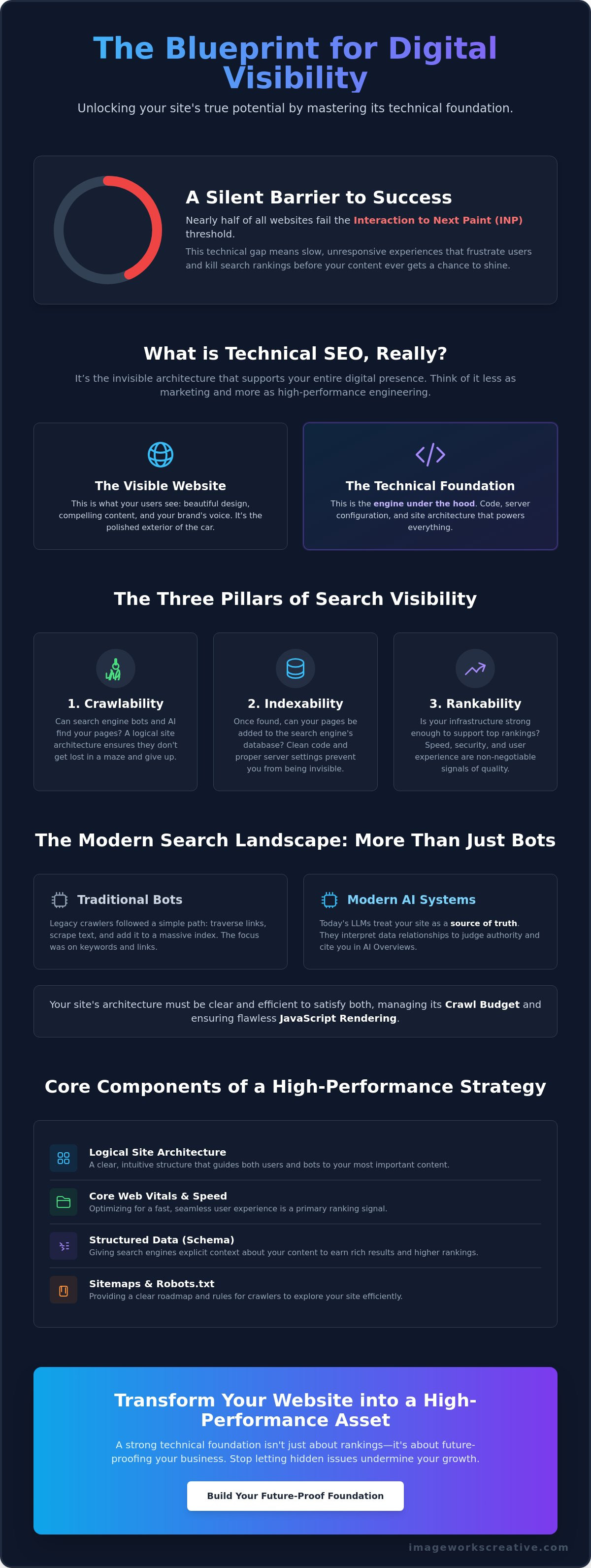
43% of websites still fail the Interaction to Next Paint (INP) threshold of 200 milliseconds, according to Digital Applied research from February 2026. This technical gap often explains why even the most sophisticated sites struggle to rank, leading many business owners to ask: what is technical seo? You've likely invested heavily in content marketing only to see your organic traffic plateau. It's a common frustration to feel like your brand is invisible to the new wave of AI search engines despite having a beautiful design.
We're here to help you bridge that gap. By mastering the architectural fundamentals of your site, you can ensure that both search engines and AI systems can discover, interpret, and rank your high-end digital presence. Our goal is to transform your website into a high-performance asset that delivers a faster, more secure user experience. This guide explores the synergy between backend performance and search visibility, covering everything from the March 2026 Core Web Vitals update to managing modern AI crawlers through a strategic Search Engine Optimization (SEO) approach.
Key Takeaways
- Understanding what is technical seo means looking past the surface to the digital plumbing that makes your site visible to both humans and machines.
- Learn how to engineer your site architecture so that search bots and AI models can easily crawl, interpret, and cite your brand.
- Discover why high-caliber custom web design and performance are inseparable when meeting the latest Core Web Vitals standards.
- See why baking technical requirements into bespoke WordPress development is the only way to ensure long-term stability.
- Master the use of structured data and sitemaps to give search engines the context they need to rank your Search Engine Optimization (SEO) efforts higher.
Beyond Keywords: Defining Technical SEO as Your Digital Foundation
Most business owners start their digital journey by focusing on the visible. They craft beautiful imagery and refine their brand voice. While these elements are vital, they represent only the surface of a much deeper ecosystem. If you've ever wondered what is technical seo, think of it as the high-performance plumbing of your digital presence. It’s the engine under the hood of a luxury vehicle. Without it, even the most striking design won't reach its destination. Technical SEO refers to website and server optimizations that help search engine spiders crawl and index your site more effectively. It ensures your infrastructure meets the high-performance requirements of modern search engines in 2026.
Technical SEO is the practice of optimizing a website’s underlying code and server configuration to ensure it is accessible, understandable, and authoritative for search algorithms. Unlike on-page SEO, which prioritizes the nuances of Search engine optimization (SEO) through content and keywords, the technical side focuses on the framework. It’s about creating a seamless synergy between your code and the bots that interpret it. When these components work as a single unit, your site becomes a high-level creation that machines can trust.
The Three Pillars of Search Visibility
To achieve a dominant search presence, your site must excel in three core areas. First is crawlability. This determines if search engine bots can actually find your pages. If your site architecture is a maze, bots will give up. Second is indexability. Once a bot finds a page, it must be able to add that page to its massive database. Code errors or server misconfigurations can block this process entirely. Finally, there is rankability. This is where your infrastructure proves it's strong enough to support high positions. A site that is fast, secure, and logically structured wins the favor of modern algorithms. Our SEO AIO optimization plan is specifically engineered to address these pillars simultaneously.
Why Technical Health is No Longer Optional
Technical debt is a silent killer of marketing ROI. It's the accumulation of outdated code, broken links, and sluggish server responses that drags down your performance. In a crowded market, technical health has shifted from a "nice to have" to a requirement for survival. Even the most compelling content will fail if it's hosted on a poorly engineered website. Search engines now prioritize the user’s experience as a primary ranking signal. If your site feels clunky or unresponsive, you aren't just losing visitors; you're losing authority. Proactive maintenance is the only way to protect your investment. Integrating high-level technical standards into your website maintenance and hosting ensures your site remains a high-performance business asset rather than a liability.
How Search Engines and AI Systems Interpret Your Site Architecture
Traditional search used to be a linear process. Googlebot would traverse links, scrape text, and add it to an index. Today, the process is far more nuanced. Understanding what is technical seo in 2026 requires a shift in perspective. You aren't just building for a bot; you're building for Large Language Models (LLMs) that treat your website as a primary source of truth. These systems don't just "read" your pages. They interpret the relationships between your data points to decide if your brand is authoritative enough to cite in an AI Overview.
This interpretation starts with the rendering process. When a search engine visits, it needs to see the same polished experience your human visitors enjoy. If your site relies on complex JavaScript that only executes on the user's browser, search bots might only see a skeleton of your content. This disconnect ruins your visibility. Efficiently managing your "crawl budget" is equally vital. Search engines allocate a specific amount of time to explore your site. If they get bogged down in low-value pages or broken links, they'll never reach your high-converting assets. Smart architecture ensures every second a bot spends on your site adds value to your rankings.
The Rendering Revolution: JavaScript and Beyond
High-performance firms often leverage sophisticated visual effects that require heavy scripting. However, client-side rendering can lead to "blank" pages for less advanced crawlers. To maintain an edge, server-side rendering (SSR) has become the gold standard. It delivers a fully rendered page to the bot immediately. This synergy between design and code ensures your aesthetic choices don't come at the cost of your search presence. You can verify this visibility by using tools that "see" through the bot's eyes, confirming that your AI-integrated web presence is fully transparent to search algorithms.
Optimizing for AI Citations and Overviews
AI systems process information through semantic clarity. They look for structured data that defines the context of your content. In the wake of the March 2026 Core Update, Google has placed a heavier emphasis on page experience signals when choosing sources for AI Overviews. Slow or unstable pages are crawled less frequently, which directly reduces your chances of being featured as a trusted answer. Your site architecture acts as the map these systems use to learn about your brand. By providing a clean, logical path, you position yourself as a reliable resource. If you're ready to refine your digital map, it might be time to start a conversation about your brand's growth.
The Synergy of Form and Function: Why Technical SEO is UX Optimization
High-end custom web design and technical performance are two sides of the same coin. They aren't competing interests. Instead, they function as a single unit to create a superior user journey. When people ask what is technical seo, they often expect a list of server settings. In reality, it's the art of ensuring your sophisticated aesthetic doesn't compromise the user's experience. A fast, secure, and seamless website builds immediate brand trust. Conversely, a slow site suggests a lack of attention to detail that can tarnish even the most established reputation. This psychological impact is profound. A one-second delay in page load time can reduce conversions by 7%, based on April 2026 data from Idea Fueled.
Mobile-first indexing has shifted the priority of digital architecture. Your desktop site is now secondary to your mobile performance. If your mobile experience is clunky, your search rankings will suffer regardless of how beautiful the desktop version looks. This synergy requires a proactive approach to engineering where every design choice is weighed against its impact on speed and stability.
Core Web Vitals in 2026: Speed, Stability, and Responsiveness
Performance is no longer a suggestion. It's a requirement. The March 2026 update tightened the "Good" threshold for Largest Contentful Paint (LCP) from 2.5 seconds to 2.0 seconds. This measures how fast your main content appears. If a visitor waits longer than two seconds, they're already looking for the exit. Interaction to Next Paint (INP) is now a primary ranking signal, yet 43% of websites still fail the 200-millisecond threshold. Finally, Cumulative Layout Shift (CLS) ensures your design stays stable. There's nothing more frustrating than a button moving just as a user tries to click it. Sites that pass all three thresholds see a 24% lower bounce rate, according to Digital Applied research from February 2026.
Security as a Ranking Signal
Security is the foundation of digital authority. HTTPS and SSL certificates are non-negotiable for any firm that takes its reputation seriously. Beyond protecting data, secure hosting acts as a direct ranking signal. Professional service firms are high-priority targets for security-related penalties because they handle sensitive client information. A "Not Secure" warning in a browser is a brand killer. Our website maintenance plans and packages prioritize these security layers, ensuring your site remains a safe harbor for your clients. Protecting your infrastructure is just as important as protecting your brand identity.
Core Components of a High-Performance Technical SEO Strategy
Building a site that dominates search results requires more than just a polished facade. It requires precision engineering. If you're still asking what is technical seo, look at it as the strategic levers that direct the flow of traffic to your most valuable assets. High-performance firms don't leave their visibility to chance. They use XML sitemaps to provide a clear roadmap for search bots, ensuring that every new insight or service update is found instantly. Simultaneously, a well-configured robots.txt file acts as a gatekeeper, preventing bots from wasting your crawl budget on administrative pages or staging environments that don't serve your growth goals.
A clean URL structure and logical site hierarchy are equally vital. Your URLs should be intuitive for both humans and machines, using clear keywords instead of strings of random numbers. We also prioritize the elimination of duplicate content. Authority dilution happens when search engines find multiple versions of the same page. By using canonical tags, you tell the algorithms exactly which version is the definitive source of truth. This protects your rankings and ensures your Search Engine Optimization (SEO) efforts remain focused and effective.
Mastering Schema Markup for Rich Results
Schema markup acts as a translator between your creative content and a search engine’s database. It provides the context that allows your brand to stand out with rich snippets, FAQ sections, and detailed service listings. Following the March 25, 2026, release of Schema.org version 30.0, the standards for structured data have become even more sophisticated. By implementing Organization and Service schema, you make it easier for AI systems to categorize your business accurately. This semantic clarity is the secret to appearing in AI-generated overviews and voice search results.
Architecture and Internal Linking
We believe in the "Three-Click Rule." No vital piece of information should be buried more than three clicks away from your homepage. This logical path doesn't just help your visitors; it allows "link juice" to flow efficiently through your site. Internal linking distributes the authority of your high-performing pages to your specific service offerings, creating a cohesive ecosystem. If you're concerned that your site's infrastructure is holding you back, our technical SEO audit services can identify the hidden bottlenecks. Ready to scale your visibility? It's time to start building your technical foundation with a team that understands the synergy of code and creative strategy.
Future-Proofing Your Growth: Integrating Technical SEO into Custom Development
Success in the digital space isn't an accident. It's the result of intentional engineering. When business leaders ask what is technical seo, they're often looking for a one-time solution. In reality, technical excellence must be baked into the design process from the first line of code. It isn't an add-on you can sprinkle over a finished site. By integrating search requirements into the initial build, you avoid the technical debt that often cripples off-the-shelf templates. This proactive approach ensures your site is ready to perform the moment it goes live, providing a high-performance foundation for your brand’s future.
Bespoke development offers a level of control that pre-packaged software simply cannot match. Whether you choose WordPress development and maintenance or a specialized Drupal build, custom code allows you to strip away the "plugin bloat" that slows down your site. This precision engineering is what enables your site to meet the tightened LCP threshold of 2.0 seconds introduced in March 2026. It’s about building a lean, agile asset that can adapt to the next decade of digital evolution.
Technical SEO is a marathon, not a sprint. The digital environment is in a constant state of flux, as evidenced by the May 2026 core update that focused on improving relevance and quality across the board. Staying ahead requires continuous monitoring and refinement. Our website maintenance plans are designed to handle this complexity for you. We treat your site as a living organism that needs regular health checks to maintain its competitive edge.
The ImageWorks Approach to Technical Excellence
We harmonize award-winning design with rigorous technical standards. Our team doesn't sacrifice aesthetic appeal for speed; we engineer them to function as a single unit. By eliminating unnecessary scripts and optimizing every asset, we ensure your site remains a high-level creation. For a deeper look at how this integration drives business results, explore our executive guide to custom website design services. This holistic view is what separates a pretty website from a high-performance business tool.
Next Steps: Evaluating Your Current Performance
If you're ready to move beyond stagnant traffic, the first step is an honest evaluation. There's a massive difference between a generic automated scan and a professional technical audit. A professional audit identifies the "low-hanging fruit," such as unoptimized images or crawl errors, that can provide immediate ranking boosts. It also uncovers the deeper architectural issues that might be hiding your site from AI search engines. We invite you to collaborate on a high-performance digital strategy that turns your technical health into a primary growth driver. Let's build something exceptional together.
Secure Your Digital Future with High-Performance Engineering
The digital landscape moves fast. You've seen how the synergy between code and design creates a high-level presence that both humans and AI systems can trust. Understanding what is technical seo is the first step toward reclaiming your search visibility and ensuring your brand isn't left behind by evolving algorithms. By prioritizing speed, security, and semantic clarity, you turn your website into a resilient asset that drives long-term growth.
ImageWorks Creative has been an award-winning agency since 1997. We bring specialized expertise in high-performance WordPress development and maintenance to every project. Our team delivers data-driven results for the legal, medical, and tech industries by focusing on the architectural details that matter most. It's time to move beyond surface-level fixes and build a foundation that lasts.
Ready to unlock your site’s full potential? Contact ImageWorks Creative for a comprehensive SEO strategy. We're excited to help your brand reach its next peak.
Frequently Asked Questions
Is technical SEO more important than content SEO?
Technical SEO and content are equal partners in your digital success. Think of it as the synergy between a high-caliber engine and premium fuel. Without a sound technical foundation, your Search Engine Optimization (SEO) efforts won't reach their full potential because search engines can't efficiently process your message. One provides the substance, while the other ensures that substance is actually deliverable to your audience.
How often should I perform a technical SEO audit?
You should perform a comprehensive audit at least once every quarter. This proactive schedule helps you catch "technical debt" before it plateaus your traffic. For firms undergoing rapid growth, checking your site health after any major update to your website maintenance plans ensures that new features haven't introduced crawl errors. Regular checkups prevent small code glitches from turning into major ranking obstacles.
Can a slow website actually hurt my search rankings?
Yes, a slow website is a direct ranking killer in 2026. Google's recent updates have made page experience a primary signal for both traditional results and AI Overviews. If your site takes too long to load, search bots will crawl it less frequently, and users will bounce before seeing your value. Speed isn't just a luxury; it's a core requirement for maintaining authority in a competitive market.
What is the difference between crawling and indexing?
Crawling is the discovery phase where search bots follow links to find your pages. Indexing is the storage phase where those pages are analyzed and added to the search engine's massive database. If you're wondering what is technical seo in this context, it's the engineering that ensures discovery leads to successful storage. A page can be crawled but still fail to index if the technical signals are confusing or broken.
Do I need a developer to handle technical SEO?
Most high-level technical fixes require a professional developer's touch. While you can manage basic metadata yourself, tasks like server-side rendering and complex schema implementation involve deep code. Partnering with experts in WordPress development and maintenance ensures these complex elements are handled with precision. Professional intervention prevents the accidental code breaks that often happen with DIY fixes.
How does technical SEO affect AI search results like ChatGPT?
AI search results rely on semantic clarity and structured data to understand the context of your brand. ChatGPT and Google's AI Overviews look for clear markers to cite sources reliably. If your site architecture is messy or your data isn't structured correctly, these systems will skip your content. A strong technical foundation makes your site a "trusted source" that AI models can easily interpret and recommend.
What are the most common technical SEO mistakes for professional firms?
Professional firms often suffer from "plugin bloat" and poor mobile responsiveness. Many also neglect their Google Business Profile rankings by failing to link their local and technical strategies correctly. These errors create a disjointed experience that frustrates both bots and high-value clients. Eliminating these bottlenecks is often the fastest way to see a significant jump in your organic performance.
Does WordPress handle all my technical SEO automatically?
No, WordPress is a powerful tool but it isn't a "set it and forget it" solution. While it's a great starting point for custom web design, it requires bespoke configuration to truly excel. Out-of-the-box themes often carry heavy, unnecessary code that needs to be refined by a specialist. You need an active strategy to ensure your specific WordPress build meets modern performance and security standards.

