Mastering Brand Style Guide Design: A Strategic Template for 2026

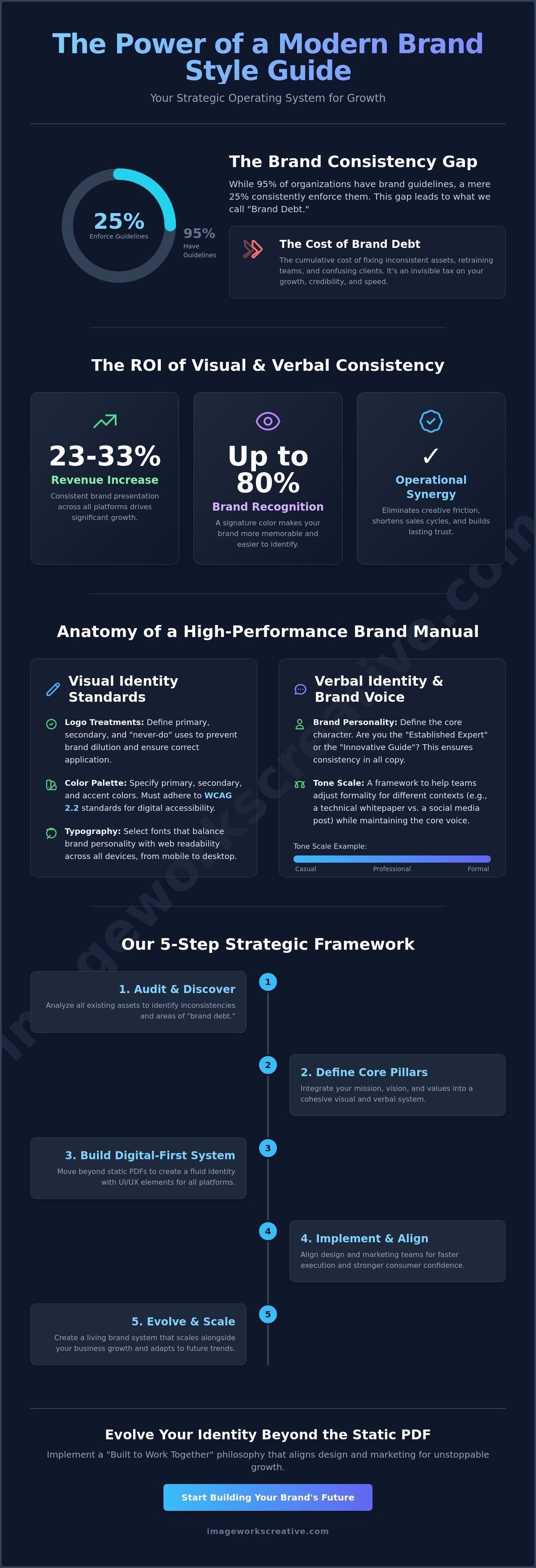
Did you know that consistent brand presentation across every digital platform can increase your revenue by an average of 23 to 33 percent? It's a staggering figure from Envive’s 2026 report. Yet, while 95 percent of organizations have guidelines, only about 25 percent actually enforce them. You've likely felt the friction of seeing an outdated logo on a partner’s site or watching your internal team struggle with inconsistent colors. It dilutes the brilliant impact of your brand style guide design and confuses your audience at the very moment they should be building trust with your business.
Instant recognition is the goal of every social media post. To achieve this, your brand style guide design must include templates for LinkedIn, Instagram, and Meta. With the dominance of mobile browsing, your guide should emphasize vertical formats, such as 1080 x 1350 pixels for portrait feed posts and 1080 x 1920 pixels for Stories and TikTok. Consistency also extends to your imagery. Define a "brand filter" or specific Photography style to ensure that even stock photos feel authentic to your firm. This disciplined approach maintains your authority in short-form video content, making your brand unmistakable in a crowded digital landscape.
We believe your marketing and web design must be built to work together. You're going to learn how to create a scalable, strategic operating system for growth that ensures visual consistency across every digital touchpoint. We'll show you how to drive marketing synergy and eliminate creative friction. We're diving into fluid identity systems, WCAG 2.2 accessibility standards, and the latest 2026 vertical social media dimensions to keep your design system modern, effective, and ready for what is next.
Key Takeaways
- Transform your visual identity into a strategic operating system by mastering modern brand style guide design that scales alongside your business growth.
- Move beyond static PDFs by adopting a digital-first approach that prioritizes UI/UX elements, ensuring your brand looks brilliant on every screen and social platform.
- Follow our strategic five-step framework to audit your existing assets and eliminate the costly friction caused by inconsistent brand drift across your internal teams.
- Implement a "Built to Work Together" philosophy that aligns your design and marketing efforts for faster execution and stronger consumer confidence.
Why Brand Style Guide Design is Your Firm’s Most Strategic Growth Asset
A brand is much more than a collection of colors and fonts; it is the DNA of your business. Think of your style guide as the operating system for your company's visual and verbal identity. It ensures every department speaks the same language and presents a unified front. When your brand style guide design is executed with precision, it eliminates the fragmentation that occurs when marketing and web design act as separate silos. This strategic foundation allows your business to move faster and with more confidence.
Fragmented design choices lead to what we call brand debt. This is the cumulative cost of fixing inconsistent assets, retraining internal teams, and confusing your potential clients. It acts as an invisible tax on your growth. When a team member uses an outdated logo on a social post or the wrong typography on a landing page, your credibility takes a hit. The shift from print-centric manuals to digital-first systems is no longer optional. In 2026, your brand must be fluid enough to thrive on mobile screens, social reels, and high-performance websites without losing its core essence.
The ROI of Visual and Verbal Consistency
Consistency isn't just about looking good. It's a direct driver of revenue. For professional service firms, a unified brand presence shortens the sales cycle by building immediate trust. When a prospect moves from a social media ad to your website and then to an email proposal, they should experience a seamless transition. This reduces creative friction, saving your marketing team countless hours. You aren't reinventing your look for every campaign; you're following a proven blueprint. This consistency builds long-term brand equity that survives market shifts and keeps your firm top-of-mind.
Moving Beyond the Logo: The Modern Brand Identity
In the digital landscape of 2026, a logo alone is insufficient. Your identity must function across a massive range of contexts, from tiny favicons to immersive video content. Modern brand style guide design focuses on creating synergy between your web design and your marketing efforts. These elements are built to work together to create a single, powerful impression. Brand equity is the cumulative value of consistent recognition that makes your business the obvious choice for your clients. We've spent decades helping firms achieve this level of brilliance by ensuring their identity is both scalable and unmistakable.
The Anatomy of a High-Performance Brand Manual: Essential Elements
A high-performance manual is more than a collection of aesthetic choices. It is a strategic blueprint that aligns your mission with your marketing execution. While many competitors focus strictly on visuals, a truly brilliant brand style guide design integrates your core pillars, mission, and vision into a cohesive system. This ensures that your service offerings don't just exist; they resonate with synergy. Every element must be built to work together to create a singular, powerful impression that builds trust with your audience.
Visual Identity Standards
Brilliant design starts with clear boundaries. Your visual standards must define primary and secondary logo treatments, including a strict "never-do" list to prevent brand dilution. Using a signature color can increase brand recognition by up to 80 percent, according to DemandSage. This makes your color palette a critical asset. Your guide should define primary, secondary, and accent palettes while prioritizing accessibility. In 2026, adhering to WCAG 2.2 standards is the baseline for digital inclusion. Typography selections must also balance personality with web readability, ensuring your message is clear on everything from a mobile device to a desktop monitor.
Our team at ImageWorks Creative specializes in crafting Brand Identity Design that captures this precise balance of art and accessibility.
Verbal Identity and Brand Voice
Your brand’s voice is the handshake that greets every potential client. It is the verbal expression of your personality. Are you the "Established Expert" who provides stability or the "Innovative Guide" leading the way? Your manual must define this personality to ensure a consistent experience in every email, blog post, and social caption. We recommend using a "Tone Scale" to help your team adjust. A technical whitepaper requires a different level of formality than a LinkedIn post, yet the underlying brand character should remain unmistakable. This messaging architecture prevents the fragmented communication that often confuses prospects and stalls the sales cycle.
Digital application is the final piece of the puzzle. Your brand lives on websites, social media, and video. It must be fluid. A static PDF is no longer enough for a modern firm. Your system should provide specific rules for UI/UX elements, including button styles, iconography, and the strategic use of white space. By defining how your brand moves and interacts in a digital environment, you ensure that every touchpoint reinforces your authority and drives marketing success.
Digital-First Branding: Adapting Style Guides for Web and Social
The era of the static, 50-page PDF is over. Traditional print-first guides often fail because they treat your brand as a fixed image rather than a living, interactive experience. A modern brand style guide design must prioritize the digital environment where your customers actually live. It's no longer enough to define how a logo looks on a business card. You must define how it behaves when a user hovers over a button or how it scales on a mobile screen. This shift ensures that your visual identity remains brilliant and functional across every digital touchpoint.
Establishing clear rules for UI/UX elements is the backbone of a digital-first system. This includes specific guidelines for iconography, button states, and the strategic use of white space to prevent visual clutter. Spacing isn't just an aesthetic choice; it's a functional tool that guides the user’s eye toward your call to action. Additionally, your brand must now account for motion. Guidelines for video production and social reels ensure that your brand’s energy remains consistent whether a viewer is watching a five-second clip or a full-length brand story. This level of detail eliminates the friction that occurs when creative partners try to guess your digital standards.
Accessibility is a non-negotiable component of modern branding. As of May 2026, the WCAG 2.2 standard remains the official benchmark for web accessibility. Your color palettes and typography hierarchies must be tested for contrast and readability from the very beginning. By baking ADA compliance into your brand identity, you protect your firm from liability while ensuring your message reaches the widest possible audience. It's a proactive approach that reflects a brand that is both inclusive and professionally authoritative.
The Synergy of Web Design and Branding
Your style guide should be the primary architect for high-performance custom WordPress development. When your design system is integrated into your site’s code, marketing execution becomes seamless. You can use your brand palette strategically to guide user behavior, using high-contrast accent colors to highlight conversion points. In 2026, variable web-safe fonts have evolved to offer unprecedented loading performance and layout flexibility across diverse browser environments. This technical optimization ensures your brand looks sharp without sacrificing site speed or search engine rankings.
Social Media and Multi-Channel Consistency
Instant recognition is the goal of every social media post. To achieve this, your brand style guide design must include templates for LinkedIn, Instagram, and Meta. With the dominance of mobile browsing, your guide should emphasize vertical formats, such as 1080 x 1350 pixels for portrait feed posts and 1080 x 1920 pixels for Stories and TikTok. Consistency also extends to your imagery. Define a "brand filter" or specific photography style to ensure that even stock photos feel authentic to your firm. This disciplined approach maintains your authority in short-form video content, making your brand unmistakable in a crowded digital landscape.
How to Design and Implement Your Brand Style Guide: A 5-Step Framework
Implementation requires more than just creative talent; it demands a disciplined process. A successful brand style guide design only works if your team can actually use it to drive results. We've developed a framework that moves your identity from a conceptual idea to a high-performance marketing asset. This process ensures that your visual and verbal elements aren't just attractive, but are built to work together for maximum impact.
Step 1: The Brand Audit and Discovery
Start by gathering every version of your logo, sales deck, and social graphic currently in circulation. You'll likely discover brand drift, where small, unauthorized changes have accumulated over time. This fragmentation confuses your audience and weakens your authority. Interview your key stakeholders to define the true north of the business. This phase isn't just about looking at what you have. It's about identifying the gaps in your current visual system that hinder your growth and create friction for your creative partners.
Synergy is the ultimate goal. You must develop your visual and verbal components simultaneously. If your brand voice is that of an established expert but your colors feel overly trendy or aggressive, you have a fundamental disconnect. We apply our signature philosophy to ensure your messaging architecture and visual cues reinforce one another at every stage. This parallel development prevents the common mistake of treating design as an afterthought. Instead, the design and the voice grow as a single, unified entity that projects brilliance and stability.
Step 2: Defining Core Brand Elements & Guidelines
Post-audit, meticulously define your brand's foundational elements. This includes precise guidelines for logo usage (clear space, variations), your full color palette (CMYK, RGB, Hex, PMS for primary/secondary colors), and your typography system (chosen fonts, hierarchy). Beyond visuals, solidify your brand voice and tone, ensuring consistency across all communications. Every element is crafted to reflect strategic insights, forming a cohesive and impactful identity that aligns with your brand's true north.
Step 3: Crafting the Comprehensive Style Guide Document
With elements defined, compile them into a clear, actionable brand style guide design document. Structure it logically with intuitive sections covering each element, complete with practical "do's and don'ts." The language must be concise and unambiguous, empowering users to apply guidelines correctly. ImageWorks Creative emphasizes creating a user-friendly manual that serves as an invaluable resource for designers, marketers, and content creators, transforming complex rules into easily digestible instructions for consistent brand expression.
Step 4: Building the Living Brand Repository
Stop sending 100MB PDFs that are outdated the moment they're saved. A web-based repository is the gold standard for 2026. This living document allows your team to download the latest SVG logos and font files instantly. It ensures everyone is working from the same source of truth, whether they're in your office or across the globe. We recommend setting a schedule for quarterly brand reviews. These updates keep the system fresh and aligned with evolving marketing goals, ensuring your brand never feels stagnant or out of touch with the market.
Step 5: Iteration, Adoption, and Continuous Evolution
Launching your guide is just the start. Ensure widespread adoption through robust training for all teams, demonstrating the "why" behind each guideline. Actively solicit feedback and conduct regular reviews – aligning with a quarterly schedule – to refine the guide and keep it current with market trends and business objectives. An effective style guide is a living document, evolving with your brand to maintain relevance and amplify its impact. This proactive approach turns your style guide into a strategic operating system that scales as your firm grows.
Ready to eliminate brand drift and unify your identity? Explore our Brand Identity Design services to start building your scalable system today.
Beyond the PDF: Evolving Your Identity with ImageWorks Creative
A static document is just the starting point for your firm's success. To truly thrive in a competitive market, your identity requires a proactive partner who understands that brand evolution is a continuous journey. Professional service firms often outgrow their initial brand style guide design because they treat it as a finished product rather than a dynamic marketing engine. We bridge the gap between aesthetic brilliance and data-driven results. Our team ensures your identity remains a powerful asset as your business scales and the digital landscape shifts.
We don't just hand over a set of rules and walk away. Our team integrates your brand identity directly into high-performance custom web builds. By aligning your visual standards with technical WordPress development, we create a seamless experience for your users. This integration ensures your site isn't just a digital brochure. It becomes a functional extension of your brand that drives conversions and reinforces your authority. When your website and marketing are built to work together, you eliminate the friction that stalls growth.
Our "Built to Work Together" Philosophy
Synergy is the core of everything we do at ImageWorks Creative. When your design and SEO strategies are built to work together, you see measurable growth in both brand recognition and organic traffic. We recently helped a legacy firm transform their outdated presence into a modern, responsive identity. By refreshing their visual system and optimizing their content marketing, they achieved a 30 percent increase in lead quality within six months. It is the result of a holistic approach where every creative choice serves a strategic business goal. Call or text us today for a brand strategy consultation to see how we can unify your vision.
Scaling Your Brand for the Future
The digital landscape of 2026 is shifting toward AI-driven search and immersive, tactile digital experiences. Your brand must be ready to adapt without losing its core essence. Maintaining brand integrity across these new frontiers requires a long-term agency partnership. We stay ahead of technical shifts to ensure your identity remains sharp, accessible, and unmistakably yours. A brand style guide design created today must be flexible enough to lead your industry tomorrow. We take your success personally and approach every project with a sense of creative excitement. Let’s build something brilliant together.
Unify Your Vision with a Scalable Brand Operating System
Your brand deserves to be unmistakable in an increasingly crowded digital landscape. We've explored how a modern brand style guide design functions as a strategic operating system that eliminates brand drift and fuels marketing synergy. By prioritizing digital-first standards and implementing a living repository, you ensure your identity remains brilliant across every touchpoint. Consistency isn't just an aesthetic goal; it is a proven driver of trust and long-term revenue growth. It's the difference between a fragmented presence and a unified authority.
ImageWorks Creative has been an award-winning agency since 1997. We are experts in high-performance web and brand synergy, offering a national reach with a boutique, collaborative feel. Our team is ready to act as your proactive partner to ensure your vision scales for 2026 and beyond. We take your success personally and approach every project with a sense of creative excitement. It is time to move beyond static PDFs and build a dynamic marketing engine that works for your business.
Ready to unify your brand? Call or text ImageWorks Creative today!
Let's work together to build a brand that is truly built to last.
Frequently Asked Questions
What is the difference between a brand style guide and brand identity?
Brand identity is the comprehensive system of visual and verbal elements that define your business, while a style guide is the strategic manual that documents how to use those elements. Identity includes your mission, logo, and personality. The guide provides the rules for application. Think of the identity as the engine and the guide as the operator’s manual that ensures every marketing effort stays on track.
How long does it take to design a professional brand style guide?
Designing a professional brand style guide typically takes between four and eight weeks. This timeline accounts for the initial audit, discovery, and the simultaneous development of visual and verbal components. Complex projects for larger firms may require additional time for stakeholder interviews and multi-channel testing. We focus on creating a system where every element is built to work together, ensuring the final product is ready for immediate implementation.
Does a small service business really need a full style guide?
Every business, regardless of size, benefits from a clear set of guidelines to prevent brand dilution. Even a small local service business needs to build trust through consistency across social media, local SEO, and email marketing. A full brand style guide design ensures you don't waste time reinventing your look for every new ad or landing page. It provides a professional foundation that helps you compete with larger firms.
How often should we update our brand guidelines?
You should perform a brand review every quarter to identify any brand drift or emerging needs. Major updates typically occur every two to three years to stay current with digital trends like vertical video formats or new accessibility standards. Your guidelines should be a living document that evolves alongside your business growth. This proactive approach ensures your identity never feels stagnant or disconnected from your audience’s changing expectations.
Can we use our brand style guide for our website redesign?
Your style guide is the essential blueprint for a successful website redesign. It defines the typography hierarchies, color palettes, and UI elements that our developers use to build high-performance custom WordPress sites. By following these standards, we ensure your site is both visually brilliant and technically optimized for conversion. Integrating your brand standards into the web design process creates the synergy needed for a seamless user experience.
What are the most common mistakes in brand style guide design?
The most common mistakes in brand style guide design include creating static PDFs that are hard to update and ignoring the brand’s verbal identity. Many guides focus solely on logos and colors but fail to define the tone of voice or messaging architecture. Failing to account for digital accessibility is another critical error. A modern guide must include rules for ADA compliance and responsive elements to function effectively in a 2026 digital environment.
How do I ensure my team actually follows the brand guidelines?
Ensuring compliance starts with making the guide accessible and easy to understand for everyone on your team. We recommend using a web-based repository rather than a buried file on a server. Hold a training session to show your team how the guide acts as a creative tool that speeds up their work. When people see that the guidelines reduce friction and improve the brilliance of their output, they're much more likely to follow them.
Should our brand style guide include social media post templates?
Including social media templates is vital for maintaining multi-channel consistency. Your guide should provide specific dimensions for 2026 vertical formats, such as 1080 x 1920 pixels for Reels and TikTok. Templates help your team produce engaging content quickly without sacrificing brand integrity. This ensures that every post, whether on LinkedIn or Instagram, feels like a necessary piece of your larger brand story and reinforces your professional authority.

