Call or text us! (703) 928-7309
What to Look for in a Marketing Agency: The 2026 Strategic Buying Guide

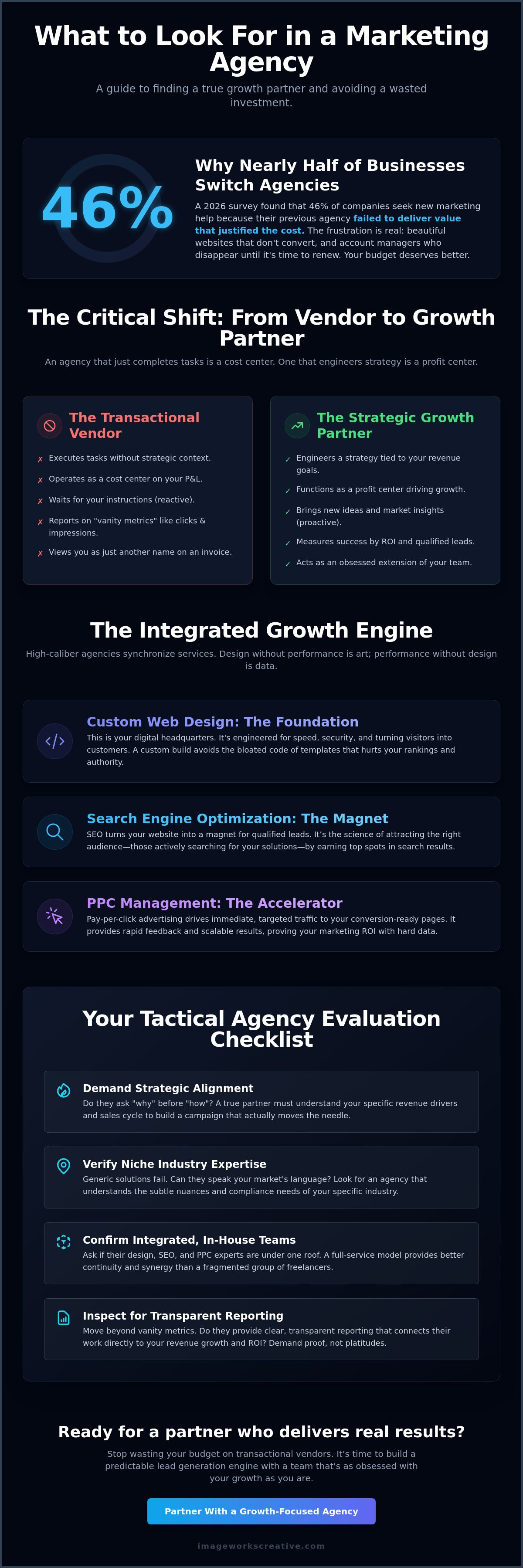
Forty-six percent of businesses seeking marketing help in 2026 are doing so because their previous agency failed to deliver value that matched the price tag. It's a staggering figure. You've likely experienced the frustration of a beautiful website that doesn't convert or the silence of an account manager who only appears when it's time to renew. We understand that your budget isn't just a number; it's the fuel for your company's future. You deserve a partner who views your growth with the same urgency you do.
Knowing exactly what to look for in a marketing agency is the difference between a wasted investment and a predictable lead generation engine. In this guide, we'll show you how to identify a high-caliber partner that treats custom web design, search engine optimization, and PPC management as a single, synchronized unit. We'll explore the shift toward hybrid pricing models, the necessity of deep industry nuance, and how to demand the transparent reporting that proves your ROI. Whether you're looking for website maintenance plans or a full brand overhaul, the goal remains the same: results that speak for themselves.
Key Takeaways
- Move beyond a transactional vendor mindset to find a growth partner that treats your specific business goals as their own.
- Discover how high-caliber custom web design and search engine optimization function in synergy to turn aesthetic appeal into a lead generation engine.
- Identify why niche industry expertise is the only way to capture the subtle nuances and compliance needs of your specific market.
- Learn why PPC management and transparent reporting are the keys to moving from vanity metrics to actual revenue growth.
- Master what to look for in a marketing agency using our 2026 tactical interview checklist to ensure your budget delivers a measurable ROI.
Establishing Your Growth Foundation: Why Strategic Alignment Matters
A 2026 survey revealed that 46% of businesses seeking fresh marketing help are doing so because their previous agency failed to provide value that justified the cost. This disconnect usually happens when the relationship is treated as a series of transactions rather than a unified growth engine. If you're only buying blog posts or ad placements, you aren't actually buying growth; you're buying tasks. While a standard definition of what is a marketing agency focuses on the creation and placement of ads, a modern high-caliber partner focuses on engineering a strategy that moves your bottom line. Knowing what to look for in a marketing agency starts with identifying this shift from vendor to visionary partner.
Identifying Shared Ambition and Vision
Shared ambition is the baseline for long-term ROI. You'll know you've found the right fit when the team asks "why" before they ever mention "how." They need to understand your specific revenue drivers and the nuances of your sales cycle. If they don't grasp the difference between a lead and a qualified opportunity in your specific industry, the campaign is destined to underperform.
The first 30 days are critical. A collaborative discovery process should feel like a deep dive into your business's DNA. This isn't just a "get to know you" call; it's a strategic alignment session where the agency maps their creative energy to your commercial objectives. They should be looking for ways to synchronize your B2B professional services goals with a technical roadmap that actually works.
Moving from Vendor to Growth Engine
An agency that executes tasks is a cost center. An agency that engineers strategy is a profit center. You need an extension of your team, not just a name on an invoice. This is why a full-service digital marketing agency often provides better continuity than a fragmented group of freelancers. When design, SEO, and data live under one roof, the synergy ensures that no part of your campaign is working in a silo.
Proactivity is the ultimate sign of a growth-minded partner. Do they bring you new ideas based on emerging market shifts, or do they wait for your instructions? A true partner prioritizes your business growth over their own billable hours by suggesting optimizations that increase efficiency. They should be obsessed with your results, constantly looking for the next lever to pull to turn your digital presence into a predictable lead generation engine.
Assessing the Synergy of Design and Performance
Design without performance is just art. Performance without design is just data. True synergy is the seamless integration of your visual brand identity and technical SEO performance. When you are deciding what to look for in a marketing agency, look for a team that refuses to separate the two. A website shouldn't just look good; it has to function as a high-performance conversion engine. This is why we view design as a strategic tool rather than just a cosmetic layer. It is the bridge between your brand's promise and the user's decision to engage.
High-caliber custom website design services are the bedrock of any successful campaign. Cheap templates might save money upfront, but they undermine your professional authority and limit your scalability. These off-the-shelf solutions often come with bloated code that slows down your site, creating a technical debt that hurts your search rankings. A custom build ensures your site is engineered for speed, security, and your specific business growth goals. It allows for a "Design-to-Conversion" pipeline where every visual element serves a specific purpose in the buyer's journey.
The Critical Link Between Web Design and Marketing
User experience (UX) acts as the primary driver for your marketing conversion rates. If a visitor can't find what they need in seconds, they leave, and your ad spend is wasted. Your brand identity must remain consistent across your ads, social media channels, and your main site to build trust. Following expert advice on choosing a marketing agency, you should evaluate an agency’s portfolio for both aesthetic appeal and functional performance. Don't just look at screenshots; click through the live sites and test the user journey yourself to see if the design actually leads to action.
Evaluating SEO and Technical Proficiency
SEO is not a "plug-in" you add at the end of a project. It's a core component of your site architecture that dictates how search engines crawl and index your value. This requires deep WordPress development agency expertise to ensure technical stability and long-term performance. Your partner should handle complex integrations, from CRM syncing to custom API work, while providing secure website maintenance and hosting services. This holistic approach keeps your growth engine running without the risk of downtime or security breaches. Understanding these technical requirements is essential when defining what to look for in a marketing agency that can scale with your business.
If you're tired of websites that look pretty but don't perform, it's time to grow your brand with a strategy that prioritizes conversion at every touchpoint.
Industry-Specific Expertise: Why Niche Experience Wins
Generalist agencies are often a gamble. While they might understand the mechanics of a Google search, they rarely understand the psychology of your specific buyer. When you're deciding what to look for in a marketing agency, niche experience should be a non-negotiable requirement. Hiring a "jack-of-all-trades" firm often means you're paying for their education. You spend the first three months of your retainer explaining your industry jargon, your sales cycle, and your competitive landscape. A partner with deep roots in b2b professional services hits the ground running on day one because they already know what keeps your clients up at night.
Industry-specific knowledge drastically reduces the learning curve at your expense. It allows an agency to skip the basic discovery phase and move straight into high-impact strategy. They understand the "why" behind your audience's behavior, which leads to messaging that actually resonates. This expertise also means they can provide more accurate benchmarks. They know what a "good" conversion rate looks like for a surgical practice or a SaaS startup, whereas a generalist might celebrate a 2% rate that's actually below your sector's average.
Specialized Knowledge for Medical, Legal, and Tech
Compliance isn't optional; it's a foundation. In medical marketing, a single HIPAA violation can lead to devastating fines. In the legal sector, Bar Association rules dictate exactly how you can present your results and expertise. A generalist firm might inadvertently put your professional license at risk by using "forbidden" keywords or non-compliant lead capture forms. This level of nuance is also why niche expertise leads to significantly better b2b social media marketing engagement. When your content speaks the language of engineers, doctors, or attorneys, you build the authority that drives high-value leads. You can test this easily during an interview by asking specific questions about your market's current regulatory challenges.
Verifying Proven Results in Your Sector
Stability is a massive differentiator. Look for agencies that have maintained a consistent presence in your field for over 20 years. This longevity proves they've successfully navigated the digital shifts that have wiped out less adaptable firms. When evaluating case studies, ask for specific examples of growth from clients that mirror your size and goals. Don't just settle for generic praise; look for testimonials from peers who understand your daily operational pressures. If an agency can't show you "blinded" data, which consists of real performance numbers with the client names removed for privacy, they likely don't have the deep sector experience they claim. This verification is a vital step in knowing what to look for in a marketing agency that can deliver a sustainable ROI.
Transparency and Data: How to Measure Marketing Success
Data is the heartbeat of business growth. But many agencies drown their clients in numbers that don't actually matter. Likes, clicks, and impressions are vanity metrics; they look good on a slide deck but don't pay the bills. When you're identifying what to look for in a marketing agency, you need a partner who prioritizes revenue metrics. You should be looking for cost-per-lead, lead-to-close ratios, and total return on ad spend. A high-caliber partner will explain how to measure marketing success in plain English, translating complex technical analytics into clear, actionable business outcomes.
Transparency is the only way to build a sustainable partnership. Avoid "black box" agencies that hide their methodology or refuse to give you direct access to your own data dashboards. You deserve to see exactly where your budget is going and how each channel is performing in real time. This level of clarity allows for agile pivoting. If a specific campaign isn't hitting its benchmarks, a data-driven agency doesn't wait for the quarterly review to fix it; they adjust the strategy immediately to protect your ROI.
Decoding Reporting and Communication Rhythms
Your monthly report should be a roadmap, not a puzzle. It needs to clearly outline your progress toward specific commercial goals and highlight the strategy adjustments made in response to the data. A dedicated account manager is vital to this process. They shouldn't just be a middleman; they should be a proactive strategist who understands your industry nuances. They act as an extension of your team, ensuring that communication is frequent, honest, and focused on your long-term vision. If you're constantly chasing your agency for updates, they aren't the right fit.
The Value of Monthly Marketing Retainers
Growth isn't a one-time event; it's a compounding process. Project-based work often leads to stalled momentum once the initial launch phase ends. Understanding what does a marketing retainer include is essential for maintaining a predictable lead generation engine. A monthly retainer provides the structural support for ongoing SEO, continuous content creation, and website maintenance and hosting services. This consistent effort builds digital authority that compounds over time, creating a competitive moat that project-based competitors can't match. It ensures your brand remains current, secure, and optimized for the latest search engine algorithms.
Ready to move beyond vanity metrics and start seeing real revenue growth? It's time to grow your brand with a partner who prioritizes your bottom line.
Making the Choice: Your Marketing Agency Evaluation Checklist
Choosing the right firm isn't just about the pitch deck; it's about the people behind the screen. As you move into final interviews, your focus should shift from broad capabilities to specific character and methodology. This is the stage where you determine if they're a vendor you have to manage or a partner you can trust. Knowing what to look for in a marketing agency during these final stages is about looking past the polished presentation to find the operational substance underneath. In 2026, the ultimate differentiator is a human-centric approach that uses technology to enhance, not replace, strategic intuition.
While automation is everywhere, your customers still crave authentic connection. A high-caliber agency understands that while data tells you what is happening, human insight tells you why. You need a team that prioritizes this connection, ensuring that your SEO optimization plan and creative content resonate on a personal level. This balance is what transforms a standard campaign into a high-performance growth engine.
Essential Questions to Ask During Your Consultation
The quality of an agency's answers will tell you more than their initial proposal ever could. Start with the basics: "Who will actually be working on my account daily?" You want to ensure that the senior experts you meet during the pitch aren't immediately replaced by junior staff once the contract is signed. Consistency in your account team is vital for maintaining the niche expertise we discussed earlier.
Next, ask how they balance ai intelligence and human expertise in their creative process. In 2026, AI is a powerful tool for efficiency, but it requires human oversight to ensure brand voice and technical accuracy. Finally, ask if they can show you a client who has been with them for five or more years. Stability is the ultimate proof of value; agencies that keep clients long-term do so because they consistently deliver a measurable ROI.
Red Flags to Avoid in Your Search
There are several warning signs that should end a consultation immediately. Guaranteed #1 rankings on Google are a major red flag. Search algorithms are far too complex for any professional firm to make such a claim; anyone who does is likely using "black hat" tactics that could lead to your site being penalized. You should also be wary of agencies that do not let you own your own data. If they use proprietary, locked-in software that prevents you from taking your analytics or ad accounts with you, they're holding your business hostage.
Transparency regarding internal processes is equally critical. If they can't explain their workflow or team structure in plain English, it's a sign of organizational chaos. Whether you are looking at local growth plans or a global brand overhaul, the agency should be an open book. At the end of the day, do the final gut check: Does this agency feel like a proactive extension of your team? If the synergy isn't there from the start, it won't appear later. Trust your instincts and choose the partner that treats your growth as their primary mission.
Ready to Engineer Your Growth?
Your marketing budget is the fuel for your company's future. It's time to stop settling for transactional vendors and start building a proactive partnership. We've covered the essential pillars of success: strategic alignment, design synergy, and the deep niche expertise required for complex sectors. Knowing what to look for in a marketing agency ensures you find a team that treats your revenue goals as their own mission.
Since 1997, we've provided award-winning design and strategy for firms that demand excellence. We specialize in the medical, legal, and tech industries, offering data-driven transparency and a dedicated account management style that keeps you in control. Every digital component we build is engineered to function as a single unit, moving you closer to your vision with every campaign. Partner with a growth agency that delivers high-caliber results. We're excited to help you build your legacy.
Frequently Asked Questions
How much should a professional marketing agency cost in 2026?
Professional agency costs vary based on your company size and specific growth goals. In 2026, the median monthly retainer for a local business falls between $3,000 and $5,000. Startups often invest $3,000 to $6,000 for foundational strategy across a few channels, while mid-market companies typically spend $10,000 to $20,000 per month for comprehensive, multi-channel campaigns. These ranges reflect the necessity of a dedicated, high-caliber team rather than a single freelancer.
How long does it typically take to see results from a new agency partnership?
You should expect to see measurable shifts in engagement and lead quality within the first 90 days. While PPC management can drive traffic almost immediately, high-caliber SEO optimization usually requires four to six months to build significant organic authority. This timeline allows your partner to stabilize technical issues and begin the compounding process of content authority. Early patience often leads to a more predictable lead generation engine.
Is it better to hire a niche agency or a full-service marketing firm?
A full-service firm is generally the superior choice because it ensures synergy between your design, strategy, and data. When your custom web design and SEO teams work under one roof, they function as a single unit rather than disconnected silos. Niche agencies offer deep sector knowledge, but they often lack the breadth to handle complex integrations or brand identity overhauls. A full-service partner provides the continuity required for long-term growth.
What is the difference between a marketing consultant and a marketing agency?
A marketing consultant primarily provides high-level strategy and advice, whereas an agency provides both the vision and the technical team to execute it. Consultants are often solo practitioners who help you identify "what" to do. An agency acts as a proactive extension of your company, handling everything from website maintenance to social media management. If you need a partner who can build and manage your growth engine, choose an agency.
How often should I expect reports and communication from my agency?
You should expect a comprehensive performance report at least once a month, supplemented by real-time dashboard access. High-caliber agencies also maintain a regular communication rhythm through bi-weekly touchpoints or weekly status updates. This ensures you're never in the dark about your budget or campaign progress. Transparent communication is a vital part of what to look for in a marketing agency to ensure your goals remain aligned as market conditions shift.
What happens if the marketing strategy is not delivering the expected ROI?
A data-driven agency will identify underperforming campaigns early and pivot the strategy based on real-time analytics. If the ROI isn't meeting expectations, the first step is a deep dive into lead quality versus volume. We don't just wait for the contract to end; we adjust the creative, the targeting, or the technical architecture to protect your investment. Successful partnerships are built on this ability to adapt quickly and protect your bottom line.
Do I need to sign a long-term contract with a marketing agency?
Monthly retainers are the most common model in 2026, used by over 60% of agencies to provide ongoing optimization. While some firms require a six or twelve-month commitment to stabilize SEO results, you should look for flexibility that prioritizes performance. A long-term contract should feel like a mutual commitment to growth rather than a legal trap. Always ensure the scope of work is clearly defined to avoid the risk of unexpected cost increases.
How do I know if an agency is actually using AI correctly or just cutting corners?
Look for the "human-centric" signature in their output. If an agency uses AI to generate generic blog posts without human oversight, your search rankings will likely suffer. Correct AI usage involves technical automation for data analysis and efficiency, while human experts handle the creative strategy and brand nuance. Ask for specific examples of how they balance ai intelligence and human expertise to ensure they aren't just cutting corners at your expense.