Why is Branding Important for a Business? The Strategic Synergy of Identity and Growth

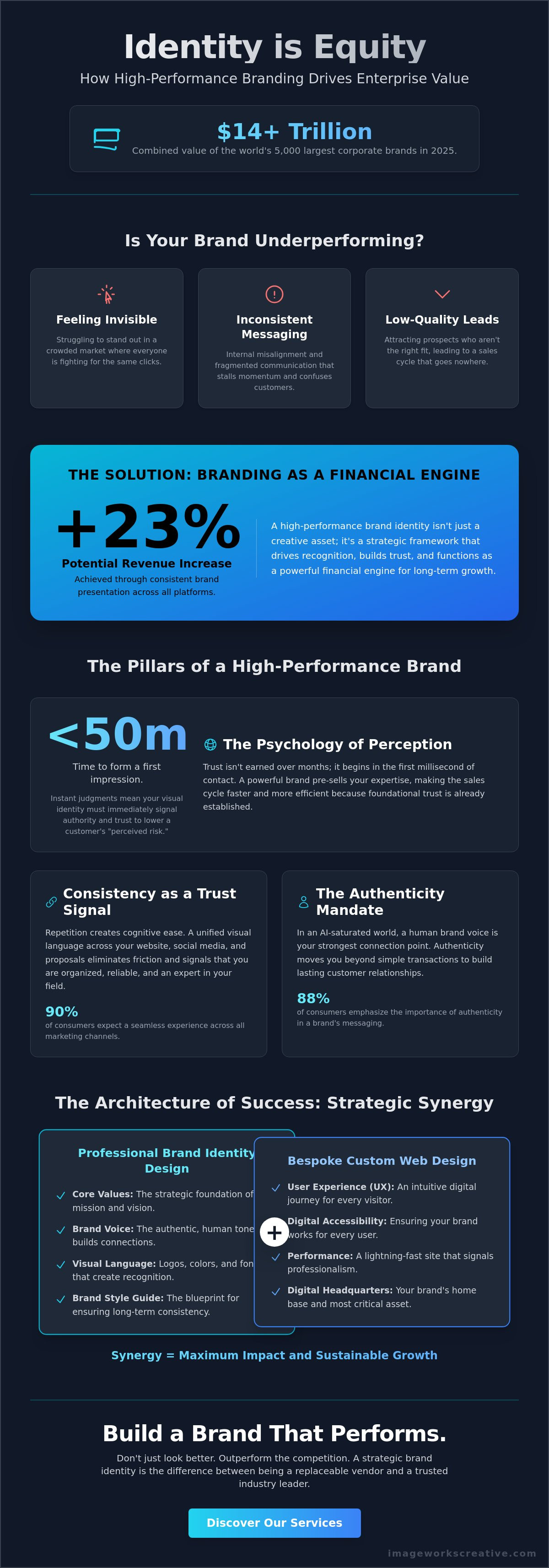
In 2025, the combined value of the world's 5,000 largest corporate brands surpassed $14 trillion. This staggering figure proves that identity is equity. If you feel invisible in a crowded market or struggle with low-quality leads, you've likely asked: why is branding important for a business when everyone is fighting for the same clicks? It's the difference between being a replaceable vendor and a trusted industry leader. Performance matters. Identity drives it.
We agree that misalignment within your team or inconsistent messaging can stall your momentum. Since consistent presentation can increase revenue by up to 23%, you deserve a clear path to authority. Discover how a high-performance brand identity functions as a financial engine, driving recognition, trust, and long-term enterprise value. We'll explore a framework for success that creates a strategic synergy between professional Brand Identity Design and bespoke Custom Web Design to ensure your business doesn't just look better, but performs at a higher level.
Key Takeaways
- Branding isn't a one-time task; it's a perpetual strategy. It's how you manage your company's cumulative assets to stay ahead of the competition.
- Your identity works as a financial engine. We'll look at why is branding important for a business that wants to command premium pricing and grow long-term enterprise value.
- First impressions happen in milliseconds. Learn to use emotional resonance to move past simple transactions and build real, lasting customer trust.
- Consistency is the key to recognition. See why every high-level identity needs a professional brand style guide design to keep the vision clear.
- Your website is your brand's digital headquarters. Discover how to create synergy between your identity and custom website design services for maximum impact.
Beyond the Logo: What Branding Means for Your Business in 2026
Branding isn't a static asset you finish and file away. It's the perpetual process of identifying, creating, and managing the cumulative assets that define your reputation. If you're wondering why is branding important for a business today, look at the noise. With global digital ad spending forecasted to exceed $850 billion in 2026, being seen isn't enough. You have to be understood. For a comprehensive overview of branding, we must look at how it has shifted from passive recognition to active engagement. It's no longer about just having a name; it's about how that name makes people feel during every interaction.
A logo is just visual shorthand. It’s a symbol for a deeper business philosophy. If that philosophy doesn't align with your technical performance, the brand breaks. True synergy happens when your identity and your execution act as a single unit. We see branding as a high-level creation that bridges the gap between your core values and your customer's needs. It's the difference between a company that sells a product and a brand that leads an industry.
The Evolution of Brand Identity
We've moved far beyond print-first thinking. In 2026, identities are digital-first and mobile-responsive by necessity. Branding now encompasses the entire user experience (UX) and digital accessibility. Does your site load instantly? Does it work for every user? Those are brand statements. Research shows 88% of consumers emphasize the importance of authenticity in a brand's messaging. In an AI-saturated market, your brand voice is the only thing that feels human. It builds authentic connections that algorithms simply can't replicate.
The "Total Identity" Concept
Your brand is the sum of every customer touchpoint. It lives in your email signatures, your social media presence, and your website's layout. Consistency across these platforms is the ultimate trust signal for B2B professional services. Currently, 90% of consumers expect a seamless experience across all marketing channels; yet, many firms still struggle with fragmentation. Without a foundation of core values, your visual identity is just hollow decoration. When those values are clear, every design choice becomes a strategic move toward growth.
The Psychology of Perception: How Branding Establishes Market Trust
The human brain is wired to make snap judgments. Studies suggest it takes less than 50 milliseconds for a visitor to form an opinion about your website and your company. This instant reaction is a primary reason why is branding important for a business aiming for high-level growth. If your visual cues don't signal authority immediately, you've lost the lead before you've even made a pitch. Trust isn't built over months; it starts in the first second of contact.
When you establish a strong identity, you're essentially lowering the "perceived risk" for your audience. This is especially true for high-ticket service providers. A client isn't just buying a service; they're buying the confidence that you'll deliver. A well-crafted brand acts as a silent partner that validates the value of branding in business by pre-selling your expertise. Familiarity breeds comfort. When your brand feels familiar, the sales cycle moves faster because the foundational trust is already there.
Consistency as a Trust Signal
Repetition creates cognitive ease. When a potential client sees the same colors, fonts, and tone across your LinkedIn, your website, and your proposals, their brain stops questioning your legitimacy. We call this a "unified visual language." The danger lies in brand fragmentation. If your social media feels playful but your website feels like a cold corporate brochure, you create friction. This confusion kills conversions. For B2B professional services, a cohesive identity is the ultimate signal that you are organized, reliable, and expert in your field.
Emotional Connection vs. Transactional Sales
Transactional sales are a race to the bottom on price. If you only talk about what you do, you're a commodity. Understanding the psychological impact of identity helps explain why is branding important for a business that wants to cultivate long-term loyalty rather than one-off sales. Research shows that 81% of consumers need to trust a brand before they consider making a purchase. This trust comes from emotional resonance. By using a story-driven identity, you create a sense of belonging. Your audience shouldn't just think you're the best option; they should feel like you're the only option that truly understands them. If you're ready to move beyond basic transactions, it's time to start engineering your brand's growth through a more human-centric strategy.
Branding as a Financial Engine: Driving Recognition and Business Value
Branding isn't a cost center. It's a financial engine. Many executives view design as a superficial expense; however, the combined value of the world's 5,000 largest corporate brands surpassed $14 trillion in 2025. This isn't an accident. It's a direct result of brand equity. When you understand why is branding important for a business, you realize it's the primary driver of perceived value. A strong identity allows you to command premium pricing because customers aren't just paying for a service. They're paying for the certainty of a high-level result.
This strategic advantage also slashes your Customer Acquisition Cost (CAC). When your brand is recognizable, you don't have to work as hard to prove your worth to every new lead. Familiarity does the heavy lifting. Research shows that brands maintaining a consistent presentation are 3.5 times more visible and can see revenue growth of up to 23%. By building a strong brand, you're investing in a machine that generates leads with less friction and higher conversion rates. It's a long-term play for enterprise value.
Attracting High-Value Customers
Bespoke branding acts as a filter. It signals to elite prospects that you operate at a higher caliber. If your identity looks cheap or dated, you'll naturally attract price-sensitive customers who have little loyalty. These clients often demand the most and pay the least. In contrast, a professional B2B professional services identity helps you close larger contracts by mirroring the sophistication of the clients you want to serve. If you want to play in the big leagues, you have to look the part.
Boosting Employee Pride and Retention
The impact of your brand isn't just external. It's the heartbeat of your internal culture. Employees want to work for a company with a clear, prestigious mission. They want to be proud of the logo on their business cards. When your team believes in the brand, they become advocates. This isn't just a "feel-good" metric. A 5% increase in customer retention can lead to a profit increase of 25-95%, and retained, happy employees are the ones who keep those customers coming back. A strong brand mission keeps your best talent from looking elsewhere, which is another reason why is branding important for a business that plans to scale.
The Architecture of a High-Performance Brand Identity
Architecture demands a blueprint. A high-performance brand identity isn't just a collection of pretty assets; it's a meticulously engineered system designed for scale. If you've questioned why is branding important for a business that already has a functional website, consider the visual equity of your competitors. A signature color can boost brand recognition by up to 80%. This isn't just about aesthetics. It's about technical performance and psychological triggers that work in unison to drive growth. We view identity as a foundational structure that supports every other marketing effort you undertake.
Visual Strategy and Logo Design
Authority is built on longevity. When designing a logo, the goal is to avoid fleeting trends that will look dated in eighteen months. You need a timeless visual anchor that signals reliability. Color psychology plays a massive role here, influencing how prospects perceive your firm’s stability and professional weight. In 2026, your visual strategy must also prioritize responsiveness. A logo that looks great on a billboard but becomes a pixelated mess as a mobile icon fails the brand. It's about creating a flexible system that maintains its integrity across every digital and physical touchpoint. This level of quality requires a strategic approach to logo design cost, treating it as an investment in your company's long-term enterprise value.
The Role of the Brand Style Guide
Consistency is the ultimate trust signal. Without a "source of truth," your marketing efforts will inevitably drift. A comprehensive brand style guide design ensures that every internal team member and external vendor speaks the same visual language. It covers everything from typography and color palettes to the specific tone of your content. This document is what allows your brand to scale without losing its soul. It's a primary reason why is branding important for a business looking to expand into new markets. When the rules are clear, the execution remains flawless across every channel.
We believe that your identity should be as functional as it is beautiful. Balancing high-level execution with technical usability is the hallmark of a modern, successful firm. If you're ready to build an identity that actually performs as a financial engine, it's time to partner with our design experts and engineer your future.
Achieving Strategic Synergy: Integrating Brand with Web and Marketing
Strategy is the foundation, but execution is the structure. If your identity and your marketing operate in silos, your growth will inevitably stall. This lack of coordination is often the hidden culprit behind high bounce rates and low-quality leads. Identity is the soul of your firm; your digital presence is the body. When they move in perfect sync, you achieve a level of market dominance that competitors simply can't touch. This is the final answer to why is branding important for a business. It's the thread that connects your core values to every click, scroll, and conversion on your site.
Total integration ensures that your brand authority isn't just a visual claim but a lived experience. Research shows that 90% of consumers expect a seamless brand experience across all marketing channels. If your social media signals innovation but your website feels like a relic from a decade ago, you've broken your brand promise. High-level execution requires that every digital component is engineered to function as a single unit. This is why partnering with a full-service digital marketing agency is so critical. It moves your brand from a series of disconnected projects to a holistic engine for growth.
Why Your Website is Your Brand’s Digital Headquarters
Your website is the ultimate proving ground. It's the primary place where your brand promise is either kept or broken. Integrating your brand voice into high-performance copywriting and UX design isn't optional; it's the standard for professional firms. A bespoke site reflects the high-end nature of your identity while driving technical results. Utilizing custom website design services allows you to build a platform that doesn't just look prestigious but is optimized for speed, accessibility, and conversion. When your site performs as well as it looks, you've achieved true synergy.
Scaling with a Proactive Partner
Brand evolution is a continuous journey. Markets shift, and consumer expectations rise. A long-term relationship with a proactive agency partner ensures your brand remains current and competitive. Continuous website maintenance plans and packages keep your digital headquarters secure and fast, while ongoing marketing retainers allow your identity to adapt to new trends like sensory and motion-first branding. If you are still wondering why is branding important for a business, look at your current conversion rates. If they aren't where you want them to be, it's time to take the next step. We invite you to schedule a consultation to audit your current brand impact and engineer a path toward lasting authority.
Engineering Your Path to Market Authority
Identity is the engine of your enterprise value. We've explored how a cohesive strategy reduces acquisition costs and builds cognitive ease for your prospects. It's clear that understanding why is branding important for a business goes beyond visual appeal; it's about creating a unified system where strategy and execution work in perfect harmony. When your brand voice and technical performance align, you stop chasing leads and start attracting high-value partnerships. This synergy is what transforms a standard company into an industry leader.
Since 1997, ImageWorks Creative has functioned as a proactive partner for ambitious firms in the medical, legal, and tech sectors. We don't just design; we engineer bespoke solutions driven by data and a deep commitment to your growth. Your brand deserves a high-level creation that commands respect and drives measurable results. It's time to move past being invisible in a saturated market and start leading with authority. We are ready to help you define your future and secure your legacy through a collaborative, visionary approach.
Elevate your brand with ImageWorks Creative’s expert identity services.
Frequently Asked Questions
What is the difference between a brand and a logo?
A logo is your firm's visual shorthand; a brand is the total sum of every interaction a customer has with your business. Think of the logo as the face and the brand as the entire personality and reputation. It includes your values, your voice, and the promise you make to your clients. While the logo is a vital asset, the brand is the strategic engine that drives long term loyalty.
How does branding help a small business compete with larger corporations?
Branding levels the playing field by allowing smaller firms to project the same level of authority and reliability as global corporations. By focusing on a bespoke identity and high-level execution, you can differentiate your services through agility and personal connection. This is a primary reason why is branding important for a business that wants to win against competitors with much larger marketing budgets and resources.
Can a business change its branding if it is no longer working?
Rebranding is a necessary strategic move when your current identity no longer reflects your firm's direction or caliber. Whether you've outgrown your original mission or your market has shifted, an identity refresh can signal a new era of growth. It's a proactive way to realign your visual language with your actual business value. We often see firms successfully pivot to attract higher-quality leads through a more sophisticated brand presence.
How long does it typically take to see the ROI of a branding project?
Internal benefits like team alignment and increased employee pride often appear immediately after a launch. Market-wide ROI typically manifests over six to twelve months as your new identity builds trust and recognition across your target audience. Over time, you'll notice higher conversion rates and a more efficient sales cycle. This is because a strong brand does the heavy lifting of pre-selling your expertise before the first meeting.
What are the most common branding mistakes professional service firms make?
The most frequent errors include inconsistent application of visual elements and failing to differentiate from competitors. Many firms use safe but generic imagery that makes them invisible in a saturated market. Another major pitfall is ignoring the synergy between your brand identity and your digital headquarters. When your website doesn't match the quality of your brand promise, you create friction that kills conversions and weakens your authority.
How does branding impact my company’s search engine optimization (SEO)?
A strong brand drives branded search traffic, which signals to search engines that your business is a trusted authority. When users recognize your brand in search results, your click-through rates naturally increase. This synergy between identity and Search Engine Optimization (SEO) creates a virtuous cycle of visibility. A well branded firm often finds it easier to rank for competitive industry terms because of its established market credibility.
Is it necessary to have a brand style guide for a mid-sized business?
A brand style guide is essential for any mid-sized business looking to scale without losing its identity. It serves as the definitive source of truth for every internal team member and external vendor you partner with. Without these guidelines, your visual language becomes diluted and fragmented. This consistency is exactly why is branding important for a business that needs to maintain a professional image across multiple marketing channels.
How often should a business re-evaluate its brand identity?
We recommend a thorough brand audit every three to five years to ensure your identity remains competitive and current. Markets evolve and digital platforms change, so staying stagnant can make your firm look dated. Regular re-evaluation helps you decide if you need a minor refresh or a more comprehensive shift. This proactive approach ensures your brand continues to function as a high performance financial engine for your company.

