Local SEO for Service Businesses That Win Work
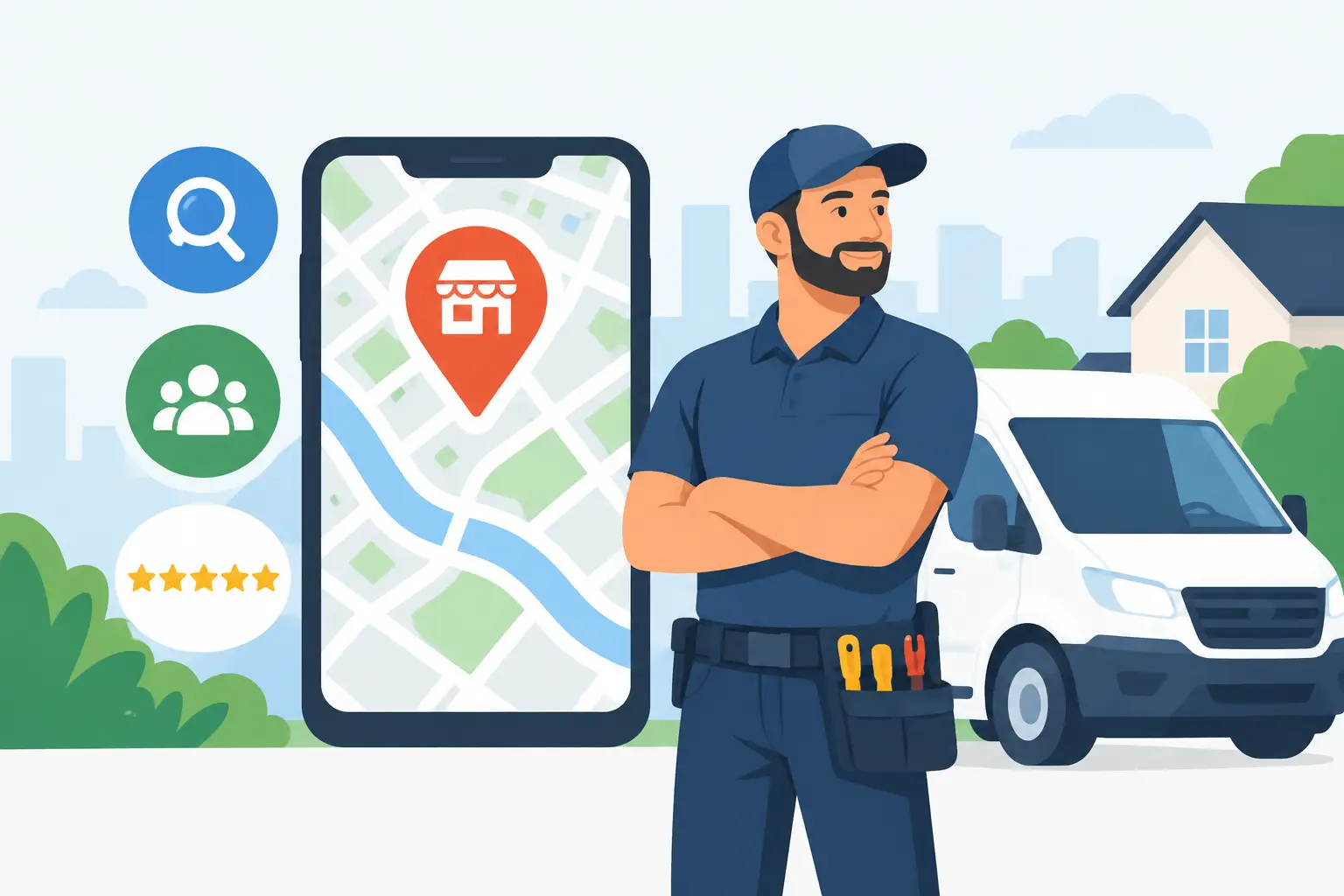
A homeowner with a burst pipe does not want a clever slogan. A facilities manager with an HVAC failure does not want to scroll through vague claims. They search, compare, check reviews, and contact the company that looks capable of solving the problem now. That is the commercial reality behind local SEO for service businesses.
Ranking is part of the job. Winning confidence before a prospect calls is the larger job. A visible Google Business Profile cannot compensate for a dated website, muddy service descriptions, weak reviews, or a contact path that breaks on mobile. Strong local visibility is a system: brand, website, content, Maps presence, reputation, and measurement working in the same direction.
Why Local SEO Is a Trust System, Not a Listings Task
Local search results are crowded with businesses that look interchangeable. Same stock photography. Same service claims. Same generic page promising “quality work” and “customer satisfaction.” If your company has decades of expertise, trained technicians, specialized equipment, or a stronger process, a generic local presence turns those advantages invisible.
Search engines are trying to identify which nearby business is relevant, credible, and likely to satisfy the searcher. Customers are doing the same thing, with less patience. They want confirmation that you serve their location, handle their specific problem, answer the phone, and have earned the trust of people like them.
That means local performance depends on more than inserting city names into page titles. Search visibility responds to relevance, proximity, prominence, and consistency. Conversion depends on clarity, proof, speed, and usability. The two must be built together.
A plumbing company may need to win emergency calls within a defined service radius. A commercial roofing contractor may need to establish credibility across several counties and convert fewer, higher-value opportunities. A law firm, medical practice, restoration company, or B2B field service provider has different buyer concerns and sales cycles. The local SEO plan should reflect that reality, not follow a one-size-fits-all checklist.
Build the Website Before You Try to Amplify It
Strong marketing cannot save a weak website. If paid traffic, Maps traffic, referrals, and organic search all land on a site that feels stale or unclear, the business pays to send prospects into a credibility gap.
Your website should quickly establish what you do, whom you serve, where you work, and why a customer should choose you. That sounds basic, but many service sites bury the answer under oversized banners, abstract brand language, or navigation that forces visitors to hunt for practical information.
Each core service needs a focused page that explains the work in customer terms. A good page addresses the problem, the scope of service, the audience or property type, common questions, evidence of expertise, and the next step. It should not be a thin paragraph copied across dozens of city pages with the location name swapped out.
Location pages are useful when they serve a real purpose. A multi-location company may need individual pages for staffed offices. A service-area business may need market pages that include relevant local context, applicable services, project examples, and distinct customer needs. If the only difference is “roof repair in Town A” versus “roof repair in Town B,” the content provides little value and can dilute the site.
Mobile experience matters especially in urgent categories. Make calls, form submissions, appointment requests, and directions easy to complete. Keep page speed under control. Show service areas plainly. Use recognizable trust signals such as licenses, affiliations, certifications, years in business, case studies, and real team or project photography where possible. No templates. No decorative clutter that hides the action a visitor needs to take.
Local SEO for Service Businesses Starts With Google Maps
For many service companies, the Google Business Profile is the front door prospects see before they ever visit the website. It deserves the same strategic attention as a key landing page.
Start with accurate fundamentals: the official business name, primary category, secondary categories that genuinely apply, phone number, website, hours, service areas, and address rules appropriate to your business model. A storefront should show its location accurately. A service-area business that does not receive customers at its address should follow Google’s guidance for hiding that address. Do not invent offices or use virtual locations to manufacture proximity. Shortcuts create risk and confusion.
Then make the profile useful. Add current photos that show real people, work, vehicles, locations, and finished results. Keep service descriptions specific. Post updates when they communicate something meaningful, such as seasonal services, new capabilities, or local project activity. Review the Questions and Answers area, and ensure your team understands how incoming messages and calls are handled.
Categories deserve particular care. Choosing the broadest possible category may feel safe, but it can blur relevance. Choosing an overly narrow category can limit visibility for legitimate work. The right mix depends on your primary revenue services, local competition, and the language customers use when they search.
Reviews Are Sales Evidence
Reviews influence both visibility and conversion, but their value is often misunderstood. The goal is not to collect a pile of vague five-star comments. The goal is to create a credible, current record of customer experience.
Build a review-request process into completed work. Ask at the moment satisfaction is highest, make the request easy, and train staff to do it consistently. A customer should never feel pressured or coached on what to say. Authenticity matters, and platforms actively police manipulation.
Useful reviews often mention the service provided, the communication experience, the location or community, and a specific outcome. Those details help future buyers see themselves in the story. A commercial client may care about jobsite coordination and deadline control. A homeowner may care about cleanliness, responsiveness, and whether the issue was actually fixed.
Respond to reviews with care. Thank positive reviewers without pasting the same reply repeatedly. Address negative feedback professionally, without arguing publicly or exposing customer details. A thoughtful response does not erase a bad experience, but it demonstrates accountability to the next prospect reading it.
Create Content That Matches Local Buying Intent
The highest-value local content is not content produced to fill a calendar. It is content that answers the questions standing between a prospect and a call.
For a service business, that may mean pages and articles addressing pricing factors, repair-versus-replacement decisions, timelines, permits, service-area conditions, maintenance concerns, or what to expect during a project. It may also mean detailed project stories that show the challenge, approach, and result. These assets support organic rankings, sales conversations, and AI-assisted search results because they give the business specific, usable information to reference.
Avoid publishing shallow pages for every possible keyword variation. A hundred thin pages do not create authority. They create maintenance debt. Fewer, better pages with real expertise, clear structure, original visuals, and accurate local context create a stronger foundation.
This is where brand matters. A company that positions itself as premium should not sound generic. A company that wins on speed should show its operational readiness. A company serving regulated industries should make compliance and process visible. The message on the website, in Google Maps, in review responses, and in advertising should reinforce the same reason to choose you.
Make Citations Consistent, Then Focus on What Moves Revenue
Business directory listings still matter, particularly when they establish consistent name, address, and phone information across major data sources. But citation work has limits. It is foundational housekeeping, not a growth strategy by itself.
Correct duplicates, outdated addresses, disconnected phone numbers, and old business names. Ensure the core information matches the website and Google Business Profile. Then resist the temptation to spend months chasing low-value directory placements while the site lacks service pages, proof, or conversion tracking.
Local authority also grows through legitimate market signals: earned local coverage, professional memberships, supplier relationships, sponsorships, community involvement, and partnerships. The right opportunities depend on the business. A regional manufacturer and a residential electrician will not build credibility in the same places.
Track Calls, Forms, and Qualified Opportunities
Traffic is not the score. A service business can rank well and still lose work if calls go unanswered, forms vanish into an inbox, or leads are never tied back to their source.
Track phone calls, form submissions, booked appointments, chat conversations, and other meaningful actions. Where practical, connect these actions to lead quality, estimates, closed revenue, and service type. This shows whether local search is producing the jobs you want, not simply activity in a dashboard.
Review performance by location, service, device, and channel. If a page gets visibility but few inquiries, the issue may be the offer, page structure, trust signals, or mobile experience. If calls are high but close rates are low, the issue may be targeting, intake, pricing expectations, or response time. Data should lead to decisions, not monthly reports that nobody uses.
Heatmaps and session recordings can reveal friction that rankings never show. Maybe users repeatedly tap a non-clickable phone number. Maybe a form asks for too much information. Maybe the service area is unclear. Small usability corrections can produce more leads than another round of keyword edits.
Treat Local Search as Ongoing Market Positioning
Local SEO is not a launch task. Competitors add reviews, Google changes result layouts, services evolve, and customer expectations rise. The companies that hold visibility are the ones that keep improving the underlying experience.
Set a regular rhythm for updating service content, adding fresh project proof, monitoring reviews, checking profile accuracy, and reviewing conversion data. Expand only when there is a clear business case, whether that means a new market, service line, or audience segment.
The best local presence makes the next decision easier for a customer: this company serves my area, understands my problem, has done this before, and looks ready to help. Build toward that standard, and every ranking has a better chance of becoming real work.

