SEO Versus Paid Search: Where Should You Invest?
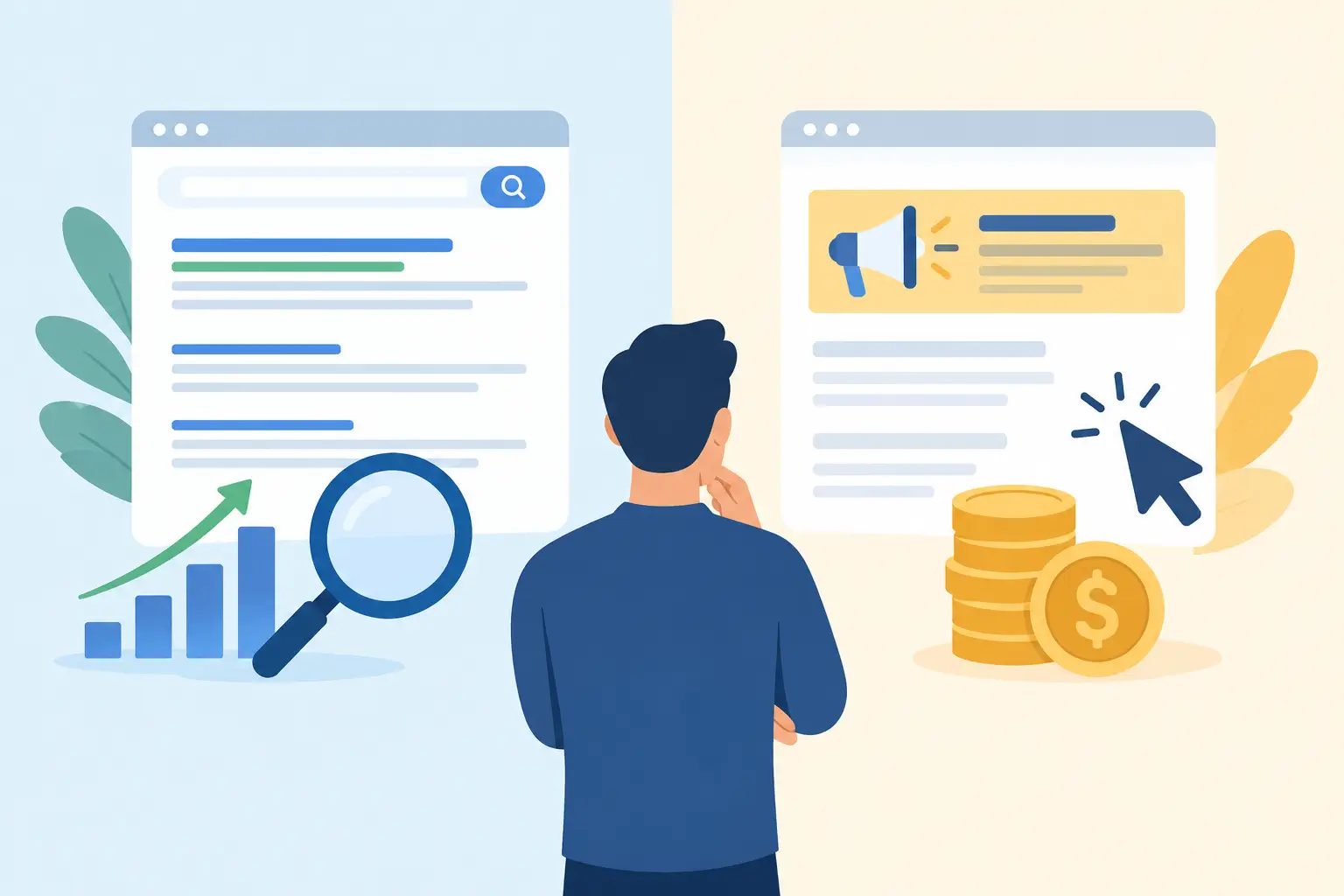
A new service line launches on Monday. The sales team needs qualified calls now, not six months from now. Paid search can put a credible offer in front of active buyers quickly. But if every lead disappears the moment ad spend pauses, the business has not built a marketing asset. That is the real business question behind SEO versus paid search: are you buying immediate attention, building durable demand, or doing both with a clear purpose?
For established businesses, the answer is rarely a simplistic choice. Search strategy should reflect your sales cycle, local market, margins, competitive position, website quality, and ability to turn traffic into conversations. Strong marketing cannot save a weak website, and neither organic rankings nor paid clicks matter much if visitors cannot quickly understand why they should trust you.
SEO Versus Paid Search Starts With the Sales Question
SEO earns visibility in organic search results through a site that is technically sound, genuinely useful, locally relevant where needed, and clearly aligned with what prospective customers want to know. It includes the architecture of the website, service pages, location pages, content depth, authority signals, Google Business Profile performance, and the quality of the brand experience once someone arrives.
Paid search places ads in front of users searching for selected terms. Businesses generally pay when someone clicks. Google Ads can produce visibility fast, provide precise geographic and audience controls, and make it easier to test offers, messages, and high-intent keywords. It is especially useful when a company needs leads during a seasonal push, market expansion, new product launch, or competitive campaign.
The critical distinction is ownership. With paid search, you rent placement. With SEO, you develop an asset that can continue attracting qualified visitors after the initial work is done. That does not make SEO free. It requires strategic investment in design, technical improvements, content, local optimization, and ongoing refinement. The difference is that a well-built organic foundation can compound rather than reset every month.
A B2B manufacturer with a nine-month buying cycle may use paid search to capture urgent requests for quote while publishing technical content that supports engineers and procurement teams at earlier stages. A local HVAC company may need paid ads during an extreme weather event, but its long-term advantage often comes from a fast mobile website, convincing service-area pages, strong reviews, and prominent map visibility. Different businesses, different mixes.
What Paid Search Does Well
Paid search is built for speed, control, and testing. Once tracking is properly configured, it can reveal which search terms drive calls, form submissions, booked consultations, and eventually revenue. That makes it valuable not just as an acquisition channel, but as a source of market intelligence.
A campaign can test whether prospects respond more strongly to "emergency repair," "same-day service," "commercial maintenance," or a specific industry solution. It can also identify which locations produce profitable leads and which audiences consume budget without advancing sales. Those insights should influence landing pages, sales scripts, content priorities, and even service positioning.
Paid search performs best when the path after the click is intentional. Sending every visitor to a generic homepage is usually a waste of budget. A strong campaign directs people to a page built around the exact need they searched for, with clear proof, relevant details, an easy next step, and call or form tracking that connects activity to outcomes.
There are trade-offs. Competitive keywords can become expensive quickly. A click is not a lead, and a lead is not necessarily a qualified opportunity. Poor account structure, broad targeting, weak negative-keyword management, or an unconvincing landing page can burn through budget while creating the false impression that search advertising does not work.
Paid campaigns also need active management. Search behavior shifts, competitors change bids, service availability changes, and winning ads eventually lose their edge. A campaign left unattended is not a growth system. It is a meter running in the background.
What SEO Does Well
SEO is the better long-range play when prospects research before they act, compare providers carefully, or search repeatedly across a complex buying journey. It helps a business show up not only for one urgent commercial phrase, but across the questions that build familiarity and trust before a buyer is ready to contact anyone.
That requires more than publishing a stack of generic articles. Thin content and cloned location pages do not create authority. Neither does a template site with vague claims and stock messaging. Search engines and human buyers both respond better when a site demonstrates real subject-matter knowledge, clear service depth, useful examples, and a distinct point of view.
For local companies, SEO also strengthens the signals that influence map results and local organic visibility. Accurate business information, location relevance, reviews, locally meaningful content, and a website that supports the service area all matter. If a customer searches on a phone, the experience must be quick, easy to scan, and built for action.
SEO takes time because trust takes time. A newer site in a competitive market will not usually outrank established competitors after a few page edits. Technical fixes may improve crawlability and user experience quickly, but meaningful ranking gains often require consistent work and patience. That is a limitation only if the business expects organic search to behave like advertising.
The upside is resilience. When your pages rank because they answer real questions better than alternatives, your visibility is not tied to an individual daily bid. Organic traffic can reduce dependency on paid media, support recruiting, strengthen sales enablement, and improve brand credibility before the first conversation begins.
The Website Is the Shared Foundation
SEO and paid search are often treated as separate vendor services. That creates a predictable problem: the ad team buys clicks, the SEO team chases rankings, and the website fails to convert either audience. The business sees reports full of activity but little clarity about what is producing revenue.
Your website should be the center of the system. It needs a clear value proposition, branded design that separates you from lookalike competitors, logical navigation, mobile performance, persuasive service pages, and conversion paths that make sense for your sales process. No Templates. No AI-Clone Design. Buyers can recognize generic work, particularly when they are choosing a high-trust professional, technical, or local service provider.
The same foundation supports both channels. A page created for a paid campaign can reveal objections and message gaps that improve organic content. An SEO page that earns traffic can become a focused landing page for a paid campaign. Search-query data can expose new service language. Call recordings, form submissions, heatmaps, and sales feedback can show why visitors hesitate.
This is where an integrated strategy outperforms disconnected tactics. The goal is not to generate more traffic at any cost. It is to create more qualified opportunities from the right audiences.
How to Allocate Budget Without Guesswork
Start with timing. If the business needs pipeline this quarter, paid search often deserves immediate investment, provided the site and tracking are ready. If the company has been paying for the same clicks for years without building organic visibility, SEO deserves a larger strategic commitment. Many businesses need both, but not necessarily in equal amounts.
Then look at economics. High-margin services, large contract values, and strong close rates can support higher paid acquisition costs. Lower-margin offers may need organic visibility and local map performance to keep customer acquisition sustainable. A business should know the value of a qualified lead, not merely its cost per click.
Competition matters as well. In a crowded market, paid search can be costly while SEO may take longer. That does not mean abandon either channel. It means prioritize the narrower opportunities competitors overlook: specific service categories, underserved locations, industry niches, high-value questions, and stronger proof of expertise.
Finally, assess the conversion foundation honestly. Before scaling spend, verify that calls, forms, booked meetings, and key sales outcomes are tracked. Review landing-page performance. Check mobile usability. Ask whether the offer is specific enough to earn action. If the site is outdated, confusing, or visually indistinguishable from competitors, fix that first. More traffic will only make the weakness more expensive.
Measure the Work That Produces Revenue
Rankings and clicks are useful indicators, but they are not the finish line. A practical search program measures organic visibility, paid-search cost, conversion rate, call quality, form quality, appointment volume, and downstream sales performance. The right dashboard connects marketing activity to business decisions.
Not every channel will receive credit at the same moment. A prospect may find your company through an organic article, return later through a branded paid ad, and finally call after reviewing your credentials. That is normal. Attribution is imperfect, but it should be good enough to show where money is being wasted, where demand is growing, and what deserves further investment.
The strongest next step is not choosing a side. It is reviewing the pages, messages, search terms, and conversion paths that stand between a motivated buyer and a productive sales conversation - then improving the weakest link first.

